
UTCTF2026-Time to Pretend
Overview
This challenge gives a login page; the form has no password, only username and otp. The goal is to find an account that is still active, generate a valid OTP, log into the portal, and get the flag.
Website analysis
When visiting the website, we see an ordinary login form. However, when viewing the page’s HTML source, there is a fairly notable comment:
<!-- NOTICE to DEVS: login currently disabled, see /urgent.txt for info -->This line tells us there is an internal file at the path /urgent.txt containing important information.
Content of the /urgent.txt file
When visiting /urgent.txt, we get the following content:
URGENT - READ IMMEDIATELY
=========================
TO: dev team
FROM: timothy
DATE: 2013-11-12 03:47:22

guys,

i think someone figured out the AffinKey system. i dont have time to explain everything
right now but there is a SERIOUS flaw in how we generate the OTPs. i only just realized
it tonight and i am freaking out.

i have locked every account in the system except mine while we figure this out. DO NOT
unlock anyone until we have patched this. i dont care if users complain. i dont care if
chad emails again. nobody gets in.

my account stays active because i need access to keep monitoring the situation. if you
need to reach me use signal.

do NOT roll back the auth system yet - i need to look at the logs first to see if anyone
has already gotten in. if they have we have a much bigger problem.

i will write up a full post-mortem once i stop shaking.

do not talk to anyone about this. not on slack. not on email. definitely not on the forum.

- timothy

p.s. i know kevin is going to say "i told you so" about building this ourselves.
he was right. i don't want to hear it.
From the content above, we can draw two important points:
- The OTP system has a serious vulnerability.
- All accounts have been locked, only
timothy’s account is still active.
Analyzing the afteahLEAK.pcap file
Next, open the afteahLEAK.pcap file in Wireshark and inspect the HTTP traffic. In it there are many requests sent to the endpoint:
POST /debug/getOTPThe data sent has the form:
{"username": "carrasco", "epoch": 1773290571}The returned response has the form:
{
  "add": 13,
  "mult": 7,
  "otp": "bnccnjbh"
}
That is, for each username and epoch, the server returns 3 values:
addmultotp
We recognize this is an Affine Cipher. The Affine Cipher encryption formula is:
E(x) = (mult * x + add) mod 26After comparing many packets in the pcap file, we have the following data pairs:
{'username': 'carrasco', 'epoch': 1773290571} -> {'add': 13, 'mult': 7, 'otp': 'bnccnjbh'}
{'username': 'mix', 'epoch': 1773290574} -> {'add': 16, 'mult': 15, 'otp': 'ogx'}
{'username': 'hebert', 'epoch': 1773290575} -> {'add': 17, 'mult': 17, 'otp': 'ghihuc'}
{'username': 'monks', 'epoch': 1773290576} -> {'add': 18, 'mult': 19, 'otp': 'myfaw'}
{'username': 'eyre', 'epoch': 1773290577} -> {'add': 19, 'mult': 21, 'otp': 'zdmz'}
{'username': 'jurado', 'epoch': 1773290579} -> {'add': 21, 'mult': 25, 'otp': 'mbevsh'}
After checking the pattern, we deduce:
add = epoch % 26The valid mult values are:
[1, 3, 5, 7, 9, 11, 15, 17, 19, 21, 23, 25]And the selection is:
mult = valid_mults[epoch % 12]Exploit script
Python script used to generate a valid OTP for the timothy account:
import requests, time

valid_mults = [1, 3, 5, 7, 9, 11, 15, 17, 19, 21, 23, 25]

def gen_otp(username, epoch):
    add = epoch % 26
    mult = valid_mults[epoch % 12]
    return "".join(
        chr((mult * (ord(c) - ord('a')) + add) % 26 + ord('a'))
        for c in username
    )

epoch = int(time.time())
otp = gen_otp("timothy", epoch)

print(otp)

s = requests.Session()
s.post("http://challenge.utctf.live:9382/auth", json={"username": "timothy", "otp": otp})
print(s.get("http://challenge.utctf.live:9382/portal").text)
After logging in successfully, the /portal page shows Timothy’s dashboard.
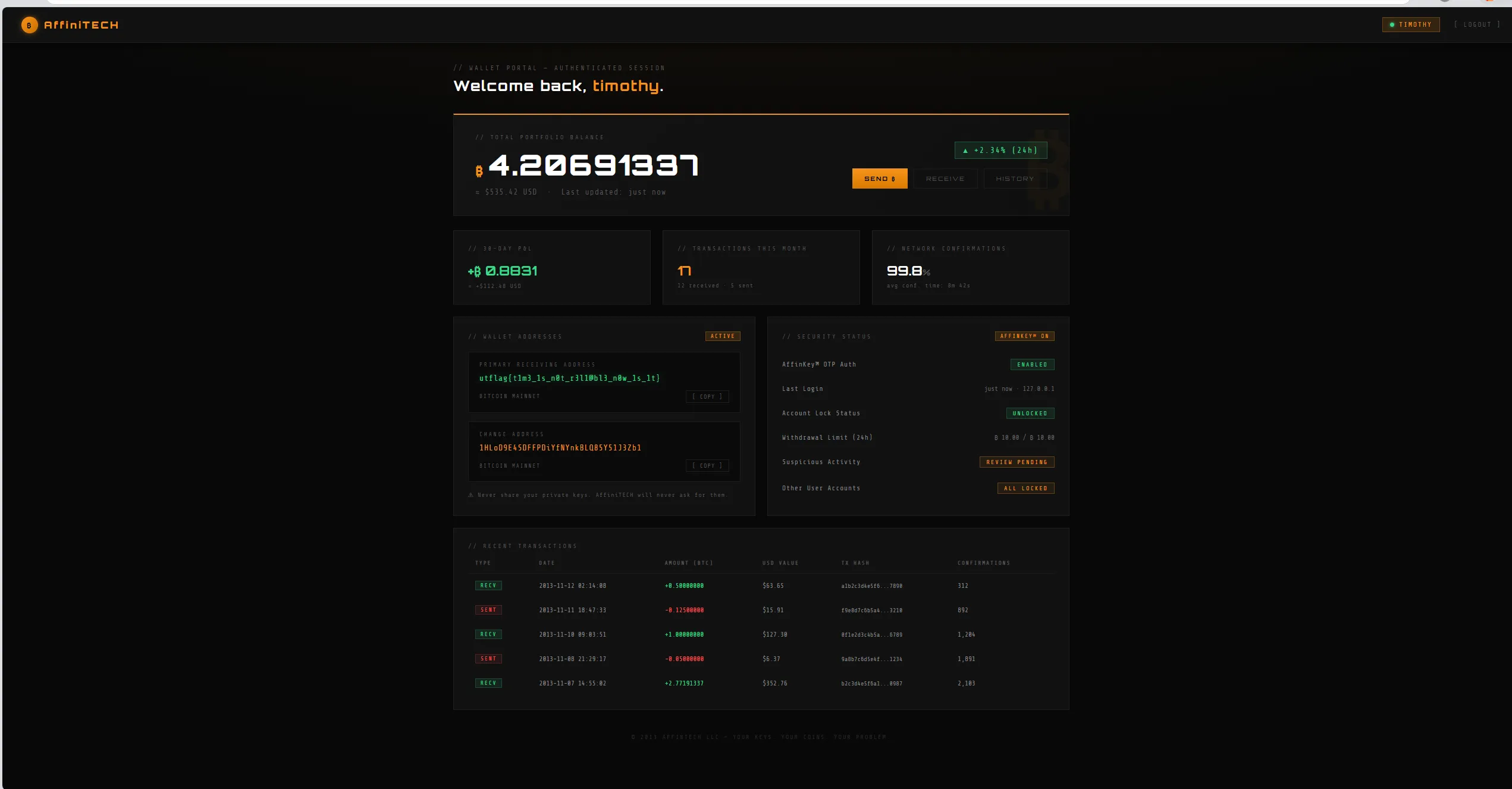
Flag
utflag{t1m3_1s_n0t_r3ll0b1l3_n0w_1s_1t}